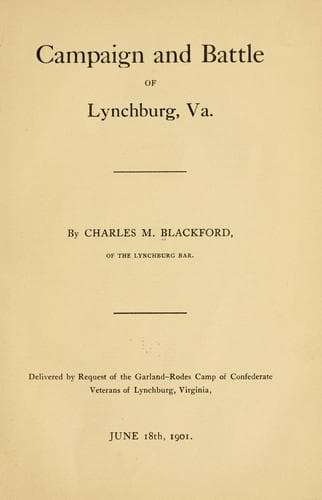
Campaign and battle of Lynchburg, Va.Blackford, Charles Minor
History
Campaign and battle of Lynchburg, Va.
Blackford, Charles Minor
Lynchburg (Va.) -- History -- Civil War, 1861-1865; Lynchburg, Battle of, Lynchburg, Va., 1864
The Second Corps was then at Gaines' Mill, near Richmond, numbering
about eight thousand muskets. (Memoirs of J.A. Early, page 40.) It
had been for the last forty days constantly fighting, and had taken
a prominent part in the battles of the Wilderness, Spottsylvania
Courthouse, Gaines' Mill and Cold Harbor, and had had no time or place
for rest or reorganization. At Spottsylvania Courthouse it lost nearly
a whole division. Its commander, Major-General Edward Johnson, had been
wounded and captured. Four of its Brigadier-Generals had been killed
during the campaign, four desperately wounded, and two more had been
promoted to Major-Generals and removed to other commands. The troops
therefore, though hardy and well-tried veterans, were in bad condition
for so arduous an undertaking. Despite these facts, so well calculated
to throw the command out of joint, it was on the march an hour before
that fixed by General Lee in his order! No one but Early knew where
they were going, but all felt that if Lee ordered the march it was
right and led to victory. When it started, Hunter was within fifty
miles of Lynchburg, while Early, on his route by Charlottesville, had
to move one hundred and sixty miles, of which a part of his troops had
the aid of very poor railway transportation for sixty miles.
On the 16th of June Early had reached Charlottesville, and his corps
was at the Rivanna bridge, four miles east of that place, having
marched eighty miles in four days, well maintaining the reputation
won under Jackson as "foot cavalry." Here Early received a dispatch
from Breckinridge announcing that Hunter was at Liberty (now Bedford
City), only distant twenty-five miles. The Orange & Alexandria Railroad
had not been sufficiently repaired for transportation in cars. Every
effort was made, however, to hurry the repairs and to secure trains
to speedily forward the troops from Charlottesville to Lynchburg, for
Early, when the perilous position of that city was known, was ordered
to push on to save it from Hunter's advancing host. He could get only
one engine and a few cars at first, but soon added to this limited
transportation enough to enable him to move a part of his command.
Duffie's attack upon the road between Charlottesville and Lynchburg
had not been very serious either to the railroad or to the telegraph
lines, and both were repaired in one or two days, hence at sunrise on
the morning of the 17th, Early commenced to move his corps by rail.
The transportation was so limited that he could only get half of his
infantry moved on that day. Ramseur's division, one brigade under
Gordon and part of another, were placed upon the train, while Rodes'
division and the residue of Gordon's were ordered to march along the
county road, which runs parallel to the railroad, and to meet the train
as it returned. The artillery and wagon trains were started over the
county road the night before, but got no aid from the railway, and did
Public-domain text, read in full here on John Shaqi.
Reviews
Reviews
No reviews yet
Be the first to share your thoughts on this work.
Join the Discussion
Join the discussion
Sign in to leave a comment or review.
Sign InorCreate an account