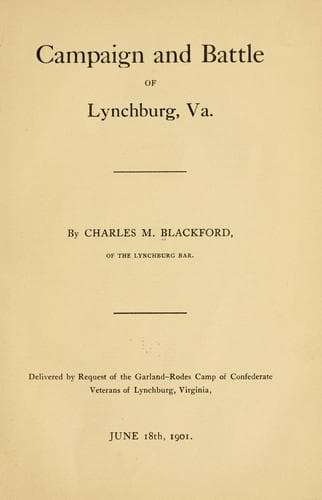
Campaign and battle of Lynchburg, Va.Blackford, Charles Minor
History
Campaign and battle of Lynchburg, Va.
Blackford, Charles Minor
Lynchburg (Va.) -- History -- Civil War, 1861-1865; Lynchburg, Battle of, Lynchburg, Va., 1864
not reach Lynchburg in time to take any part in the engagement at that
point. Rodes demanded the right to be sent forward with his division
ahead of Ramseur, on the ground that he should be called upon to defend
his native city. This privilege, from some unaccountable reason, was
denied him, a denial which led to high words between Early and himself.
General Early was on board the first train, but so indifferent was the
motive power, and so bad the condition of the track, that he and the
first half of his corps did not reach Lynchburg until the afternoon of
the 17th, and the rest of his small army did not arrive until nearly
night the next day--too late to take part in the engagement. Early
found Breckinridge in bed suffering from the injury to which reference
is made above, and as Breckinridge could not go out to reconnoitre,
he had called upon General D.H. Hill, who happened to be in the city,
to ascertain and define the best lines of defence. This duty was
performed by General Hill, with the assistance of General Harry T.
Hays, of Louisiana, who was also in town disabled by a wound received
at Spottsylvania Courthouse. Hill established the line close to the
city in breastworks, which had been thrown up on College Hill. These
were at once occupied by the disorganized infantry force which had
been defeated at Piedmont under Jones, the Virginia Military Institute
Cadets, and the invalid corps. To this was added Breckinridge's small
command, when it arrived on the 16th, and Douthat's battery.
Early, on his arrival, thought this line too near the city for the
main defence. He feared that in case of battle the shot and shell of
the enemy would do damage to the property and the people of the town;
consequently a new line, further out, was established, to which were
taken the troops with Early, Breckinridge's men and the artillery.
When he reached the field on the afternoon of the 17th, Early found
Imboden with his small remnant of cavalry, and McCausland with his
little brigades, occupying the hill at the old Quaker Meeting House,
on the Salem Turnpike. This cavalry, with their gallant leaders, was
holding the enemy in check, which was a great achievement, and was one
absolutely essential to the safety of the city. They were, however,
very slowly driven back as the main body of Hunter's army advanced.
The small force under Ramseur, which arrived on the evening of the
17th, was at once thrown forward and occupied the new line established
by Early, across the Salem Turnpike, about two miles from the city and
a mile and a half beyond Hill's line on College Hill. This force, with
two guns of Breckinridge's command, in charge of Lieutenant Carter
Berkeley, of Staunton, now Dr. Carter Berkeley, of Lynchburg, two guns
of Lurty's battery, some of the guns of Floyd King's battalion and two
of Douthat's battery, were placed in the redoubt near the toll-gate and
stayed the advance of the enemy until dark closed the engagement for
the day.
Public-domain text, read in full here on John Shaqi.
Reviews
Reviews
No reviews yet
Be the first to share your thoughts on this work.
Join the Discussion
Join the discussion
Sign in to leave a comment or review.
Sign InorCreate an account