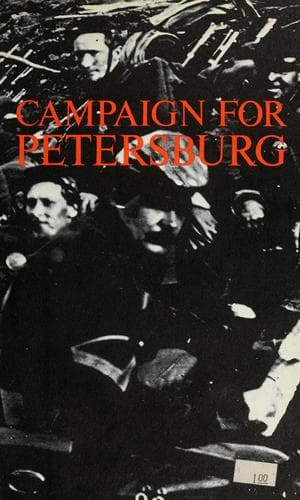
Petersburg (Va.) -- History -- Siege, 1864-1865; Virginia -- History -- Civil War, 1861-1865
Such a man was found in Maj. Gen. Ulysses S. Grant, the victor at
Vicksburg and Missionary Ridge, who was brought east and, on March 9,
1864, commissioned lieutenant general to be responsible for all the
Union armies. Unlike his predecessor, Henry W. Halleck, Grant decided
not to remain in Washington but chose instead to accompany the Army of
the Potomac, where he would provide general direction to the military
operations but leave the execution of them to that army’s commander,
Maj. Gen. George G. Meade.
[Illustration: _Maj. Gen. George G. Meade commanded the Army of the
Potomac during the 1864-65 Virginia campaign. With General Grant
actively directing most of the military operations, Meade was in the
awkward position of serving much like a corps commander in his own
army. He nevertheless functioned well in this difficult situation._]
UNION STRATEGY 1864
To accomplish the conquest of the Confederacy, the Northern plan called
for a huge two-pronged attack. Maj. Gen. William T. Sherman, in command
of the southern prong, was assigned the task of destroying Gen. Joseph
E. Johnston’s Confederate Army of Tennessee, capturing Atlanta, marching
to the sea, and then turning north to effect a junction with Grant.
It was the upper arm of the movement which was directly concerned with
Richmond and Petersburg. This was composed of two armies: the Army of
the Potomac and the Army of the James. It was the task of these armies
to capture Richmond, crush the Army of Northern Virginia, and march
south toward Sherman.
The story of the Army of the James in the early phase of the offensive
can be briefly told. Maj. Gen. Benjamin F. Butler was ordered to advance
upon Richmond from the southeast and threaten communications between the
Confederate capital and the Southern States. With some 40,000 Union
troops, the advance was begun. City Point, located at the junction of
the James and Appomattox Rivers and soon to be the supply center for the
attack on Petersburg, was captured on May 4, 1864. Within 2 weeks,
however, a numerically inferior Confederate force shut up the Army of
the James, “as if it had been in a bottle strongly corked,” in Bermuda
Hundred, a loop formed by the winding James and Appomattox Rivers. Here
Butler waited, while north of him the Army of the Potomac and the Army
of Northern Virginia engaged in a series of bloody battles.
Public-domain text, read in full here on John Shaqi.
Reviews
Reviews
No reviews yet
Be the first to share your thoughts on this work.
Join the Discussion
Join the discussion
Sign in to leave a comment or review.
Sign InorCreate an account