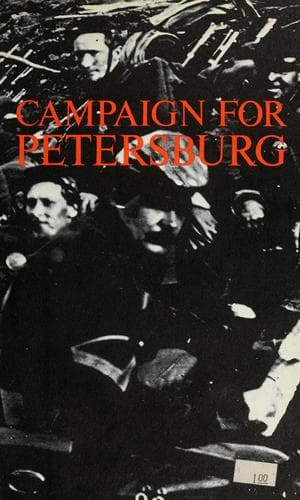
Petersburg (Va.) -- History -- Siege, 1864-1865; Virginia -- History -- Civil War, 1861-1865
The Battle of the Wilderness, May 5-7, 1864, began what proved to be the
start of the final campaign against the Army of Northern Virginia. Here
Meade’s Army of the Potomac, numbering approximately 118,000 troops,
fought the Confederate defenders of Richmond. Lee had about 62,000 men
with him, while an additional 30,000 under Gen. P. G. T. Beauregard held
the Richmond-Petersburg area. The battle resulted in a fearful loss of
men on both sides, although the armies remained intact. This was
followed by a series of fierce engagements around Spotsylvania Court
House from May 8 to 21.
Failing to destroy the Army of Northern Virginia in these battles, Grant
moved the Army of the Potomac to the east of Richmond. It was his hope
that he would outflank the Confederate defenders by persistent night
marches. Lee was not to be so easily outguessed, however. After minor
battles at the North Anna River (May 23) and Totopotomoy Creek (May 29),
Grant arrived at Cold Harbor, about 8 miles northeast of Richmond, but
Lee’s army still stood between him and that city. On June 3, 2 days
after he arrived at Cold Harbor, Grant ordered a direct frontal assault
against the Confederate lines. He was repulsed with heavy losses—about
7,000 men. “I have always regretted that the last assault at Cold Harbor
was ever made,” Grant would write many years later. By the end of the
first month of Grant’s campaign, both sides had suffered heavy
casualties, but the North’s ability to refill its depleted ranks was
greater than the South’s. Lee’s offensive strength had been sapped. From
the Battle of Spotsylvania Court House until the end of the war, except
for counterattacks and the lunge at Fort Stedman during the siege of
Petersburg, the Army of Northern Virginia was a defensive weapon only.
After Cold Harbor, Grant decided to turn quickly to the south of
Richmond and isolate the city and the defending troops by attacking
Petersburg and cutting the railroads that supplied them. Lee knew he
could not allow this to happen. “We must destroy this army of Grant’s
before he gets to James River,” he told one of his generals. “If he gets
there, it will become a siege, and then it will be a mere question of
time.”
STRATEGIC PETERSBURG
According to the United States census of 1860, Petersburg was a city of
18,266 people. It was situated on the southern bank of the Appomattox
River about 8 miles from City Point, where the Appomattox joins the
James, and 23 miles south of Richmond. As the war progressed and the
territory to the north and east was shut off, Richmond became
increasingly dependent on Petersburg for supplies. Through it passed a
constant stream of war materials and necessities of life from the South
to sustain the straining war effort. In short, Petersburg was a road and
rail center of vital importance to the Confederacy, and its capture
would almost certainly lead to the abandonment of Richmond.
Public-domain text, read in full here on John Shaqi.
Reviews
Reviews
No reviews yet
Be the first to share your thoughts on this work.
Join the Discussion
Join the discussion
Sign in to leave a comment or review.
Sign InorCreate an account