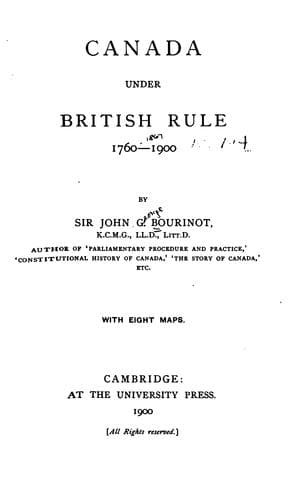
Canada under British Rule 1760-1900Bourinot, John George
History
Canada under British Rule 1760-1900
Bourinot, John George
Canada -- History
It was during Champlain's administration of affairs that the Company of
the Hundred Associates was formed under the auspices of Cardinal
Richelieu, with the express object of colonizing Canada and developing
the fur-trade and other commercial enterprises on as large a scale as
possible. The Company had ill-fortune from the outset. The first
expedition it sent to the St. Lawrence was captured by a fleet commanded
by David Kirk, a gentleman of Derbyshire, who in the following year also
took Quebec, and carried Champlain and his followers to England. The
English were already attempting settlements on the shores of
Massachusetts Bay; and the poet and courtier, Sir William Alexander,
afterwards known as the Earl of Stirling, obtained from the King of
England all French Acadia, which he named Nova Scotia and offered to
settlers in baronial giants. A Scotch colony was actually established
for a short time at Port Royal under the auspices of Alexander, but in
1632, by the treaty of St. Germain-en-Laye, both Acadia and Canada were
restored to France. Champlain returned to Quebec, but the Company of the
Hundred Associates had been severely crippled by the ill-luck which
attended its first venture, and was able to do very little for the
struggling colony during the three remaining years of Champlain's life.
The Recollets or Franciscans, who had first come to the country in 1615,
now disappeared, and the Jesuits assumed full control in the wide field
of effort that Canada offered to the missionary. The Jesuits had, in
fact, made their appearance in Canada as early as 1625, or fourteen
years after two priests of their order, Ennemond Massé and Pierre Biard,
had gone to Acadia to labour among the Micmacs or Souriquois. During the
greater part of the seventeenth century, intrepid Jesuit priests are
associated with some of the most heroic incidents of Canadian history.
When Champlain died, on Christmas-day, 1635, the French population of
Canada did not exceed 150 souls, all dependent on the fur-trade. Canada
so far showed none of the elements of prosperity; it was not a colony
of settlers but of fur-traders. Still Champlain, by his indomitable
will, gave to France a footing in America which she was to retain for a
century and a quarter after his death. His courage amid the difficulties
that surrounded him, his fidelity to his church and country, his ability
to understand the Indian character, his pure unselfishness, are among
the remarkable qualities of a man who stands foremost among the pioneers
of European civilization in America.
Public-domain text, read in full here on John Shaqi.
Reviews
Reviews
No reviews yet
Be the first to share your thoughts on this work.
Join the Discussion
Join the discussion
Sign in to leave a comment or review.
Sign InorCreate an account