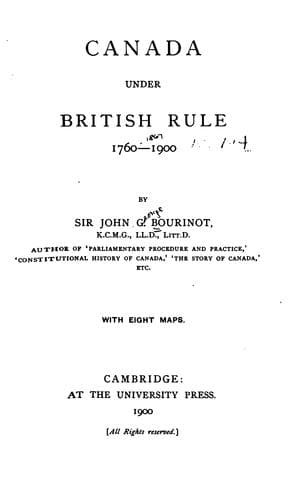
Canada under British Rule 1760-1900Bourinot, John George
History
Canada under British Rule 1760-1900
Bourinot, John George
Canada -- History
in honour of Queen Anne, and was formally ceded with all of Acadia
"according to its ancient limits" to England by the treaty of Utrecht.
[1: This name is now generally admitted to belong to the language of the
Micmac Indians of the Atlantic provinces. It means a place, or locality,
and is always associated with another word descriptive of some special
natural production; for instance, Shubenacadie, or Segubunakade, is the
place where the ground-nut, or Indian potato, grows. We find the first
official mention of the word in the commission given by Henry IV of
France to the Sieur de Monts in 1604.]
It was not in Acadia, but in the valley of the St. Lawrence, that France
made her great effort to establish her dominion in North America. Samuel
Champlain, the most famous man in the history of French Canada, laid the
foundation of the present city of Quebec in the month of June, 1608, or
three years after the removal of the little Acadian colony from St.
Croix Island to the basin of the Annapolis. The name Quebec is now
generally admitted to be an adaptation of an Indian word, meaning a
contraction of the river or strait, a distinguishing feature of the St.
Lawrence at this important point. The first buildings were constructed
by Champlain on a relatively level piece of ground, now occupied by a
market-house and close to a famous old church erected in the days of
Frontenac, in commemoration of the victorious repulse of the New England
expedition led by Phipps. For twenty-seven years Champlain struggled
against constantly accumulating difficulties to establish a colony on
the St. Lawrence. He won the confidence of the Algonquin and Huron tubes
of Canada, who then lived on the St. Lawrence and Ottawa rivers, and in
the vicinity of Georgian Bay. Recognizing the necessity of an alliance
with the Canadian Indians, who controlled all the principal avenues to
the great fur-bearing regions, he led two expeditions, composed of
Frenchmen, Hurons, and Algonquins, against the Iroquois or Confederacy
of the Five Nations[2]--the Mohawks, the Oneidas, Onondagas, Cayugas,
and Senecas--who inhabited the fertile country stretching from the
Genesee to the Hudson River in the present state of New York. Champlain
consequently excited against his own people the inveterate hostility of
the bravest, cruellest and ablest Indians with whom Europeans have ever
come in contact in America. Champlain probably had no other alternative
open to him than to become the active ally of the Canadian Indians, on
whose goodwill and friendship he was forced to rely; but it is also
quite probable that he altogether underrated the ability and bravery of
the Iroquois who, in later years, so often threatened the security of
Canada, and more than once brought the infant colony to the very verge
of ruin.
[2: In 1715 the confederacy was joined by the Tuscaroras, a southern
branch of the same family, and was then called more properly the Six
Nations.]
Public-domain text, read in full here on John Shaqi.
Reviews
Reviews
No reviews yet
Be the first to share your thoughts on this work.
Join the Discussion
Join the discussion
Sign in to leave a comment or review.
Sign InorCreate an account