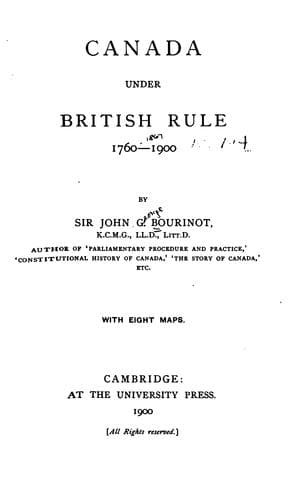
Canada under British Rule 1760-1900Bourinot, John George
History
Canada under British Rule 1760-1900
Bourinot, John George
Canada -- History
The Scottish immigration, which has exercised such an important
influence on the eastern counties of Nova Scotia--and I include Cape
Breton--commenced in 1772, when about thirty families arrived from
Scotland and settled in the present county of Pictou, where a very few
American colonists from Philadelphia had preceded them. In later years a
steady tide of Scotch population flowed into eastern Nova Scotia and did
not cease until 1820. Gaelic is still the dominant tongue in the eastern
counties, where we find numerous names recalling the glens, lochs, and
mountains of old Scotland. Sir William Alexander's dream of a new
Scotland has been realised in a measure in the province where his
ambition would have made him "lord paramount."
Until the foundation of Halifax the government of Nova Scotia was vested
solely in a governor who had command of the garrison stationed at
Annapolis. In 1719 a commission was issued to Governor Phillips, who was
authorised to appoint a council of not less than twelve persons. This
council had advisory and judicial functions, but its legislative
authority was of a very limited scope. This provisional system of
government lasted until 1749, when Halifax became the seat of the new
administration of public affairs. The governor had a right to appoint a
council of twelve persons--as we have already seen, he did so
immediately--and to summon a general assembly "according to the usage of
the rest of our colonies and plantations in America." He was, "with the
advice and consent" of the council and assembly, "to make, constitute
and ordain laws" for the good government of the province. During nine
years the governor-in-council carried on the government without an
assembly, and passed a number of ordinances, some of which imposed
duties on trade for the purpose of raising revenue. The legality of
their acts was questioned by Chief Justice Belcher, and he was sustained
by the opinion of the English law officers, who called attention to the
governor's commission, which limited the council's powers. The result of
this decision was the establishment of a representative assembly, which
met for the first time at Halifax on the 2nd October, 1758.
Governor Lawrence, whose name will be always unhappily associated with
the merciless expatriation of the French Acadians, had the honour of
opening the first legislative assembly of Nova Scotia in 1758. One
Robert Sanderson, of whom we know nothing else, was chosen as the first
speaker, but he held his office for only one session, and was succeeded
by William Nesbitt, who presided over the house for many years. The
first sittings of the legislature were held in the court house, and
subsequently in the old grammar school at the corner of Barrington and
Sackville Streets, for very many years one of the historic memorials of
the Halifax of the eighteenth century.
Public-domain text, read in full here on John Shaqi.
Reviews
Reviews
No reviews yet
Be the first to share your thoughts on this work.
Join the Discussion
Join the discussion
Sign in to leave a comment or review.
Sign InorCreate an account