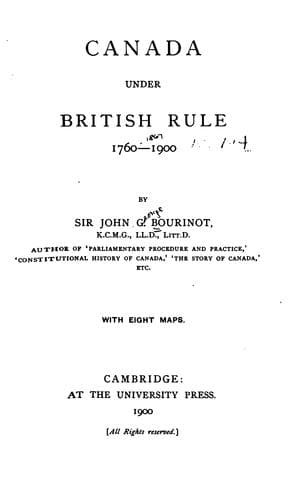
Canada under British Rule 1760-1900Bourinot, John George
History
Canada under British Rule 1760-1900
Bourinot, John George
Canada -- History
At this time the present province of New Brunswick was for the most part
comprised in a county known as Sunbury, with one representative in the
assembly of Nova Scotia. The island of Cape Breton also formed a part of
the province, and had the right to send two members to the assembly, but
the only election held for that purpose was declared void on account of
there not being any freeholders entitled by law to vote. The island of
St. John, named Prince Edward in 1798, in honour of the Duke of Kent,
who was commander-in-chief of the British forces for some years in North
America, was also annexed to Nova Scotia in 1763, but it never sent
representatives to its legislature. In the following year a survey was
commenced of all the imperial dominions on the Atlantic. Various schemes
for the cultivation and settlement of the island were proposed as soon
as the surveys were in progress. The most notable suggestion was made by
the Earl of Egmont, first lord of the admiralty; he proposed the
division of the island into baronies, each with a castle or stronghold
under a feudal lord, subject to himself as lord paramount, under the
customs of the feudal system of Europe. The imperial authorities
rejected this scheme, but at the same time they adopted one which was as
unwise as that of the noble earl. The whole island, with the exception
of certain small reservations and royalties, was given away by lottery
in a single day to officers of the army and navy who had served in the
preceding war, and to other persons who were ambitious to be great
landowners, on the easy condition of paying certain quit-rents--a
condition constantly broken. This ill-advised measure led to many
troublesome complications for a hundred years, until at last they were
removed by the terms of the arrangement which brought the island into
the federal union of British North America in 1873. In 1769 the island
was separated from Nova Scotia and granted a distinct government,
although its total population at the time did not exceed one hundred and
fifty families. An assembly of eighteen representatives was called so
early as 1773, when the first governor, Captain Walter Paterson, still
administered public affairs. The assembly was not allowed to meet with
regularity during many years of the early history of the island. During
one administration it was practically without parliamentary government
for ten years. The land question always dominated public affairs in the
island for a hundred years.
Public-domain text, read in full here on John Shaqi.
Reviews
Reviews
No reviews yet
Be the first to share your thoughts on this work.
Join the Discussion
Join the discussion
Sign in to leave a comment or review.
Sign InorCreate an account