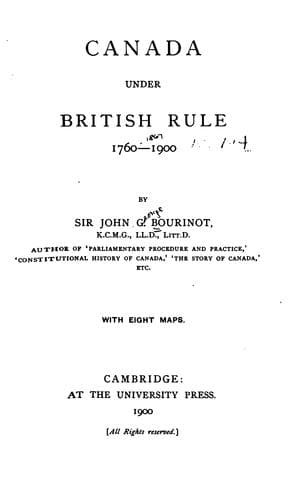
Canada under British Rule 1760-1900Bourinot, John George
History
Canada under British Rule 1760-1900
Bourinot, John George
Canada -- History
In the reign of Queen Elizabeth, the English began to take a prominent
part in that maritime enterprise which was to lead to such remarkable
results in the course of three centuries. The names of the ambitious
navigators, Frobisher and Davis, are connected with those arctic waters
where so much money, energy, and heroism have been expended down to the
present time. Under the influence of the great Ralegh, whose fertile
imagination was conceiving plans of colonization in America, Sir
Humphrey Gilbert, his brother-in-law, took possession of Newfoundland on
a hill overlooking the harbour of St. John's. English enterprise,
however, did not extend for many years to any other part of North
Eastern America than Newfoundland, which is styled Baccalaos on the
Hakluyt map of 1597, though the present name appeared from a very early
date in English statutes and records. The island, however, for a century
and longer, was practically little more than "a great ship moored near
the banks during the fishing season, for the convenience of English
fishermen," while English colonizing enterprise found a deeper interest
in Virginia with its more favourable climate and southern products. It
was England's great rival, France, that was the pioneer at the beginning
of the seventeenth century in the work of exploring, and settling the
countries now comprised within the Dominion of Canada.
France first attempted to settle the indefinite region, long known as
_La Cadie_ or _Acadie_[1]. The Sieur de Monts, Samuel Champlain, and the
Baron de Poutrincourt were the pioneers in the exploration of this
country. Their first post was erected on Dochet Island, within the mouth
of the St. Croix River, the present boundary between the state of Maine
and the province of New Brunswick; but this spot was very soon found
unsuitable, and the hopes of the pioneers were immediately turned
towards the beautiful basin, which was first named Port Royal by
Champlain. The Baron de Poutrincourt obtained a grant of land around
this basin, and determined to make his home in so beautiful a spot. De
Monts, whose charter was revoked in 1607, gave up the project of
colonizing Acadia, whose history from that time is associated for years
with the misfortunes of the Biencourts, the family name of Baron de
Poutrincourt; but the hopes of this adventurous nobleman were never
realized. In 1613 an English expedition from Virginia, under the command
of Captain Argall, destroyed the struggling settlement at Fort Royal,
and also prevented the establishment of a Jesuit mission on the island
of Monts-Déserts, which owes its name to Champlain. Acadia had
henceforth a checquered history, chiefly noted for feuds between rival
French leaders and for the efforts of the people of New England to
obtain possession of Acadia. Port Royal was captured in 1710 by General
Nicholson, at the head of an expedition composed of an English fleet and
the militia of New England. Then it received the name of Annapolis Royal
Public-domain text, read in full here on John Shaqi.
Reviews
Reviews
No reviews yet
Be the first to share your thoughts on this work.
Join the Discussion
Join the discussion
Sign in to leave a comment or review.
Sign InorCreate an account