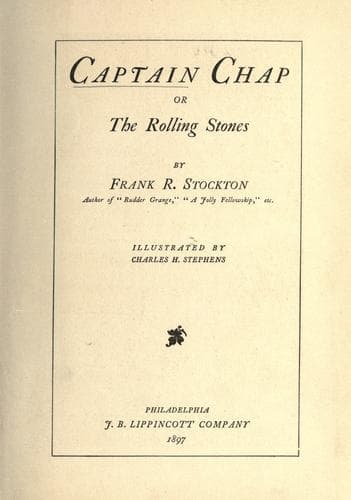
Captain Chap; or, The Rolling StonesStockton, Frank R.
General
Captain Chap; or, The Rolling Stones
Stockton, Frank R.
Florida -- Juvenile fiction; Teenage boys -- Juvenile fiction
This passage through the woods was, when the size of the bend of the
tributary river was considered, a short cut between the landing-places
on the two streams; but it was, for all that, a long walk, and it was
late in the afternoon when The Talker announced to Chap that they were
approaching the bank of the other river.
“How do we know that we are going to strike the river at the right
place to meet the rascals?” asked Chap. “They may land on the opposite
bank, and then we can’t get at them.”
“Only one landin’-place ’long here,” said the Indian; “but just where
we are goin’ to go. Ketch ’em there. You see. Just wait.”
The Indians now called a halt, and after a few words among themselves,
The Talker informed Chap that they had determined to remain where they
were until after nightfall, because, if the men on the boat caught
sight of any of them, they would suspect something, and would not land
at all.
“Sit down; rest,” said The Talker. “I’ll go see if boat has come along
yit.”
“I thought it wouldn’t do for you to show yourself,” said Chap, sitting
down on a fallen tree-trunk, while the three Indians sat upon the
ground.
“Ain’t goin’ to look; goin’ to ask,” said The Talker, as he disappeared
into a by-path, which Chap had not noticed before.
In about half an hour The Talker returned, and, much to Chap’s
surprise, he was accompanied by a young white girl, carrying a pail.
“This is Mary Brown,” said The Talker.
The three Indians then arose, and shook hands with Mary Brown, with
whom they seemed to be very well acquainted.
The young girl offered Chap her hand, and said, as she put down her
pail,--
“I’ve brought you some supper; I’d had you come up to the house, but he
tells me,” pointing to The Talker, “that you don’t want to be seen.”
“Do you live in these woods?” asked Chap, in amazement.
“Yes,” said Mary Brown, “we live about half a mile back thar. ’Tain’t
on the river, but it’s on high ground, with a clearin’ ’round it, so
that people can be seen pretty plain from the water. He asked me if I’d
seed a boat come up to-day, but I’m jist certain none has come up yit,
for I’d been sure to see it. I’ve been watchin’ out for father. He’s
gone up Indian River. I don’t ’spect him back to-day, but I might as
well watch.”
The girl took a piece of corn-bread from her pail, and gave it to Chap,
and offered him the first choice of a plate of cold fried bacon. Chap
was obliged to take this food in his fingers, but he was glad enough to
get it, and said nothing about the absence of plates, knives, and forks.
“I’ll bring you down some coffee after a while,” said Mary Brown, “but
I hadn’t made any fire when that Indian came up to the house.”
She gave the rest of the corn-bread and bacon to the Indians, and then
came and sat down by Chap.
“He tells me,” said she, “that some fellows have stole your boat, and
that you’re goin’ to try to take it away from ’em again.”
Public-domain text, read in full here on John Shaqi.
Reviews
Reviews
No reviews yet
Be the first to share your thoughts on this work.
Join the Discussion
Join the discussion
Sign in to leave a comment or review.
Sign InorCreate an account