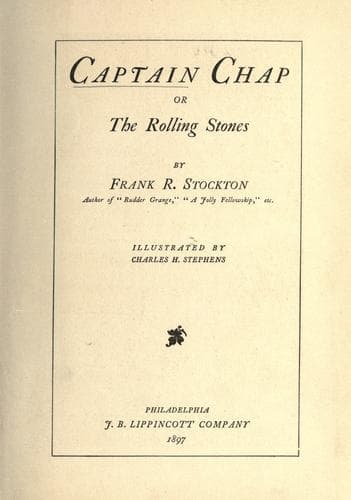
Captain Chap; or, The Rolling StonesStockton, Frank R.
General
Captain Chap; or, The Rolling Stones
Stockton, Frank R.
Florida -- Juvenile fiction; Teenage boys -- Juvenile fiction
“That is what we started out to do,” said Chap, “but I’m very much
afraid this plan won’t work. We are not even sure that the men who
stole the boat came up this river, for I did not stay to see which way
they went; and if they did come up this way, why should they land at
the particular place where these Indians expect to find them, and to
which there is a track right through the woods from the place where
they stole the boat?”
“You let these Indians alone,” said the girl, “for knowin’ jist what
people are goin’ to do, ’specially fellers that are huntin’ and
fishin’. I don’t reckon them boat-thieves ever heard thar was a good
campin’-place up here, but they can’t help findin’ it out, for all the
way up from the mouth of the river there’s nothin’ but reeds and swamps
and ’gators; and when they git to the bit of hard, white sand down
thar, which they can see ever so fur away, they’ll be sure to come to
it. Everybody does who goes along this river,--that is, if they come
up this fur. Of course, they may have turned ’round and gone back long
ago, but you’ve got to take your chances of that. As for this track
through the woods, I don’t suppose they know anything about it, and if
they did, they wouldn’t ’spect you to find it. And now I must go up to
the house, and look out for the boat. You and the Indians had better
keep shady till I tell you whether it’s comin’ or not.”
Mary Brown belonged to the class of people which in Florida are called
“crackers.” These are poor whites, generally found in the half-settled
portions of the State, who make a scanty living by fishing, hunting,
and cultivating small patches of ground. They are usually uneducated.
As a rule, they are an orderly people, and many of them are by nature
intelligent and bright.
Mary Brown had been thrown a good deal on her own resources, and she
had learned to take a very common-sense view of the things that came
under her observation. She wore a large sun-bonnet, and no shoes or
stockings, and seemed afraid of nothing in the shape of man or beast
which she might meet in the wild forest that surrounded her solitary
home, where at present she was left with her mother and an old negro
man, who acted as general helper about the place.
When she had gone, the Indians sat talking among themselves, while Chap
folded his arms and stood leaning against a tree.
“I don’t half like the way things are going,” he said to himself. “It
don’t seem to me that I’m exactly commanding this party, although I
regularly hired them, and took them into my service. They’re doing
everything just as they please, and I shouldn’t wonder if the whole
thing should turn out a fizzle. But if we get a chance to do anything,
I’ll soon let them know that I’m captain.”
About fifteen minutes after this, Mary Brown came hurrying to them. She
carried a tin-cup of hot coffee, sweetened, but with no milk in it,
which she gave to Chap.
Public-domain text, read in full here on John Shaqi.
Reviews
Reviews
No reviews yet
Be the first to share your thoughts on this work.
Join the Discussion
Join the discussion
Sign in to leave a comment or review.
Sign InorCreate an account