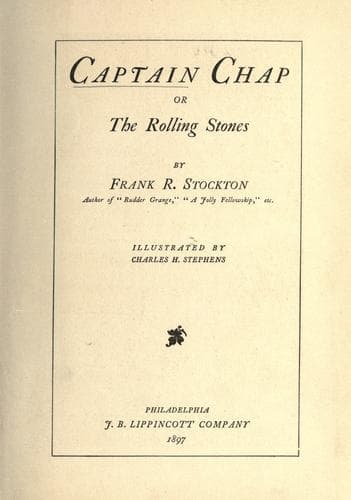
Captain Chap; or, The Rolling StonesStockton, Frank R.
General
Captain Chap; or, The Rolling Stones
Stockton, Frank R.
Florida -- Juvenile fiction; Teenage boys -- Juvenile fiction
“Perhaps some steamboat will come out after us when they find we don’t
come back,” suggested Phœnix.
“That may be,” said the captain, willing to give his young passengers
as much encouragement as possible. “But you fellows had better get
something to eat, and turn in. You’ll be more comfortable in your bunks
while we are rolling about in this way.”
But Chap and Phil did not want anything to eat. The very idea was
horrible to them. And so Phœnix ate his hard biscuit and some cold
meat, for there seemed to be no intention of even boiling a pot of
coffee, and then he crawled into his little bunk.
“Boys,” groaned Chap, “I don’t care for a tug-boat as much as I used
to.”
“Care for it!” said Phil, in a weak voice. “I hope I may never----”
And here his remark ended; he was too sick to say what he hoped.
The night was a horrible one. Occasionally the boys slept; but as they
found, whenever they dropped into a doze, they were very apt to roll
out of their bunks, they were obliged to keep awake most of the time.
As soon as daylight appeared, they were all anxious to go outside,
feeling that a breath of fresh air would be better than anything
else in the world. This the captain, who seemed to have been up all
night, would not allow.
[Illustration: The rescue.]
“You’d be washed overboard,” he said, “and things are bad enough as
they are, without any of you getting drowned. There’s a regular gale
off shore, and we haven’t sighted an inward-bound steamer yet.”
In the course of an hour or two, it was evident that a vessel ought
to be sighted very soon, for the tug, which was not built for such
rough work as this, had, in spite of the efforts of the crew to make
everything tight on the decks, shipped a good deal of water, and it was
necessary to work the pumps. But this did not help matters, for it was
found that a leak had sprung somewhere, and the water came in faster
than it could be pumped out.
The tug was now far from the land, and in the path of coastwise
steamers; and before noon the welcome sight of a line of smoke appeared
on the horizon. It was a steamer which was approaching them, but,
unfortunately, it was going southward, and not northward.
“She’s a Savannah steamer,” said the captain, “but we’ve got to git on
board of her, no matter where she is going; for this old boat can’t
stand this sort of thing much longer. We’ve been blowing out from
shore all night, and there’s no time for anything to come out after us
now.”
The boys looked aghast.
“Savannah!” they cried. “We don’t want to go to Savannah!”
“It’s a good sight better place than the bottom of the ocean,” said the
captain.
It was a bad bargain for the boys, but they had to make the best of it.
“What are you going to do in Savannah?” asked Phœnix, in a tone of
dismay.
“It can’t take us more than a couple of days to get there,” said Phil,
“and then we can telegraph home. As soon as our folks know where we
are, I shall feel that everything is all right.”
Public-domain text, read in full here on John Shaqi.
Reviews
Reviews
No reviews yet
Be the first to share your thoughts on this work.
Join the Discussion
Join the discussion
Sign in to leave a comment or review.
Sign InorCreate an account