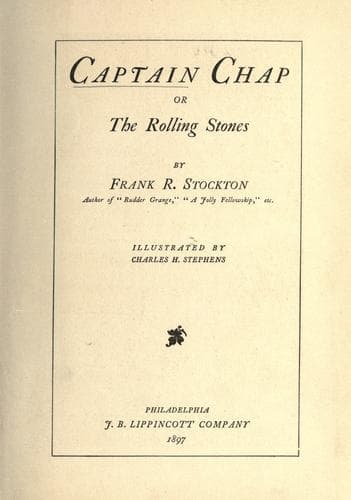
Captain Chap; or, The Rolling StonesStockton, Frank R.
General
Captain Chap; or, The Rolling Stones
Stockton, Frank R.
Florida -- Juvenile fiction; Teenage boys -- Juvenile fiction
“I shan’t feel that anything is all right until we know where we are
ourselves,” said Chap, looking out of one of the little windows of the
cabin. “Did you ever see such a pokey old steamer as that is? I believe
we shall sink before she gets to us.”
But this unfortunate event did not happen, although the tug was very
deep in the water and rolling heavily when the steamer lay to, with her
bow to the wind, a few hundred yards away from them.
A large boat was speedily lowered and rowed to the tug. In less than
half an hour the unfortunate occupants of the sinking tug-boat had been
taken on the steamer.
A few articles were brought away from the tug, and the boys were
allowed to carry with them their valises.
As soon as the boat-load of people was on the steamer, and the boat
hauled up to its davits, the vessel put about, and proceeded on her way.
As the boys looked back, they saw the little tug, with her smoke-stack
very much on one side, and but little of her hull visible, tossing and
pitching on the waves.
“She isn’t good for another half-hour,” said the engineer, who stood by.
The party rescued from the sinking tug-boat was very kindly received on
board the steamer, but it was quite evident, even to the hopeful and
enthusiastic Chap, that there was no intention of putting back for the
Breakwater.
The boys had never been on an ocean steamer before, and would have been
greatly delighted with their present experience had it not been for the
feeling that every movement of the ponderous engine beneath them was
taking them farther and farther from their homes.
It would be impossible for their friends to hear from them for at least
two days, and the news that the tug-boat had gone out to sea, and never
returned, would probably reach Boontown very soon.
All three were very much dejected when they thought of the misery and
grief which the intelligence would cause in their families, and Phœnix
seemed more downcast than either of the others.
“If father believes I’m drowned,” he said, “it’ll be just his way to
go about grieving that he worked me too hard. I know I made him think
that, but I didn’t do so much after all.”
“If my folks look at the thing in that light,” said Chap, “they’ll
grieve that they didn’t get more out of me before I was drowned.”
“I don’t believe there’ll be as much mourning as you think,” said Phil.
“Uncle will be on hand, and he’s been in so many scrapes, and pulled
through them all, that he knows just about how things will turn up. I
bet it won’t be half an hour after he hears the news before he thinks
out the whole thing, and has made all your people see that it’s as
clear as daylight that we’ve been carried out to sea, and picked up by
some steamer, and that we’ll be heard from soon after she gets to her
port. He’ll know that there wasn’t storm enough to wreck a good, stout
tug-boat, and that something must have got out of order, so that she
was carried out to sea.”
Public-domain text, read in full here on John Shaqi.
Reviews
Reviews
No reviews yet
Be the first to share your thoughts on this work.
Join the Discussion
Join the discussion
Sign in to leave a comment or review.
Sign InorCreate an account