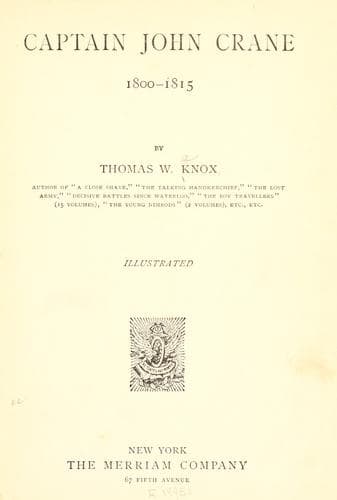
United States -- History -- War of 1812 -- Fiction
After the health officer had visited us he went ashore, and it was not
long before the story of the Warwick, the sufferings of the people on
board of her, and her relief by the American ship that came into port
with her, became known in Gibraltar. The captain of the port came off
to visit both ships, a very unusual thing for him to do, and he made
arrangements to take our captain with him to call upon the Governor
of Gibraltar the next day. When the call was made the governor was
very civil to Captain Dawson, and said he had performed an act of
humanity which deserved high recognition when all its circumstances
were considered. He said he should report the circumstances to his
government, and hoped that Captain Dawson and our second mate would
be suitably rewarded. The captain thanked him for his good wishes,
and said he trusted entirely to the generosity of a government whose
maritime power was the greatest in the world.
Then he told about the affair with the Algerine pirate, to which the
governor listened attentively. He laughed heartily over the incident
of the rockets, which were, he said, the invention of Sir William
Congreve, and this was the first time he had known of their use in
actual warfare. He also laughed over Captain Dawson's description of
the consternation created among the piratical crew when the rocket was
let loose among them, and especially when the captain told about the
jumping overboard. He said he should mention this matter in his next
report, as it might prove of great importance to the government.
I may add here for the reader's information that these rockets were
intended to explode and hurl leaden balls and scraps of iron among the
enemy. They were particularly calculated to frighten horses and break
up cavalry operations generally, and when tried in actual warfare
they were nearly as destructive among infantry. They were first
tried successfully in warfare and with fatal effect at the attack on
Copenhagen in 1807.
One great advantage of these rockets is that they make no recoil
against the stand from which they are fired; the largest rocket can
therefore be discharged without danger from the smallest boat, and
consequently, in naval attacks on fortresses and cities, a flotilla of
rocket boats is generally used. The great disadvantage of this missile
is the uncertainty of its course. It was a very lucky circumstance
that we were enabled to throw the two rockets that were sent from the
Warwick directly on board the Algerine; but we were very near her, and
thus had a much better aim than if she had been farther away.
Public-domain text, read in full here on John Shaqi.
Reviews
Reviews
No reviews yet
Be the first to share your thoughts on this work.
Join the Discussion
Join the discussion
Sign in to leave a comment or review.
Sign InorCreate an account