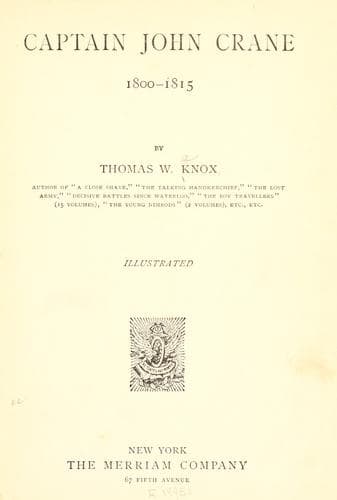
United States -- History -- War of 1812 -- Fiction
Since I quit the sea and sat down to write this narrative I have read
somewhere that the Duke of Wellington was invited to witness a trial of
the Congreve rocket soon after it was invented and perfected. The duke
was on horseback, surrounded by a large and handsomely uniformed staff;
the group was assembled at the top of a small hill which commanded a
view of the plain where the experiments were to take place.
A few rockets had been let off, and the duke seemed well satisfied
with their performance. Finally one rocket, at its discharge, took an
erratic course, and came directly into the midst of the distinguished
party, where it fizzed and sputtered while darting here and there, and
then, dashing off to one side, exploded. If the explosion had taken
place directly in the group, some of the officers would probably have
been killed or wounded; as it was the horses were frightened, and fully
one-half the party were thrown to the ground and had to walk home,
or wait till their horses were caught and brought to them. From that
moment the Duke of Wellington was never favorable to the use of the
Congreve rocket.
But I am getting away from my story. As the news spread about Gibraltar
of the saving of the Warwick and those whom we found on board of
her, the officers and crew of the Washington became the objects of
considerable attention. Captain Dawson did not neglect to take the
proper steps for obtaining his claim for salvage; he employed a lawyer
of Gibraltar to attend to the matter, and it is proper to say that the
lawyer did his duty faithfully. The claim was considerably reduced
by the court, but nevertheless it was a handsome compensation, and
everybody concerned on our side of the affair felt well rewarded for
his trouble. A special award was made to Mr. Johnson and the six men
who went with him on board the Warwick; this was done, we understood,
at the instance of the Governor of Gibraltar, who seemed rather more
kindly disposed toward us than was usually the case with English
officers toward Americans at that time.
When any of the crew of the Washington obtained liberty to go on shore
they were treated kindly, and very often, too, by the British sailors
and landsmen. One effect of the hospitality of Gibraltar was that those
of our crew who were not abstemious from drink generally returned to
the ship much the worse for their excursion.
One afternoon several of us, including Haines and myself, had
permission to go ashore. It was very hot that day, and we found it
rather fatiguing work to walk about.
Public-domain text, read in full here on John Shaqi.
Reviews
Reviews
No reviews yet
Be the first to share your thoughts on this work.
Join the Discussion
Join the discussion
Sign in to leave a comment or review.
Sign InorCreate an account