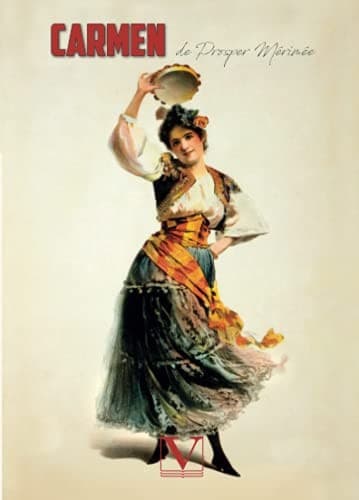
Carmen (Fictitious character) -- Fiction; Spain -- Social life and customs -- 19th century -- Fiction
I have been told that one day a party of good-for-nothing fellows banded
themselves together, and bribed the bell-ringer at the cathedral to ring
the Angelus some twenty minutes before the proper hour. Though it was
still broad daylight, the nymphs of the Guadalquivir never hesitated,
and putting far more trust in the Angelus bell than in the sun, they
proceeded to their bathing toilette--always of the simplest--with an
easy conscience. I was not present on that occasion. In my day, the
bell-ringer was incorruptible, the twilight was very dim, and nobody but
a cat could have distinguished the difference between the oldest orange
woman, and the prettiest shop-girl, in Cordova.
One evening, after it had grown quite dusk, I was leaning over the
parapet of the quay, smoking, when a woman came up the steps leading
from the river, and sat down near me. In her hair she wore a great
bunch of jasmine--a flower which, at night, exhales a most intoxicating
perfume. She was dressed simply, almost poorly, in black, as most
work-girls are dressed in the evening. Women of the richer class only
wear black in the daytime, at night they dress _a la francesa_. When she
drew near me, the woman let the mantilla which had covered her head
drop on her shoulders, and “by the dim light falling from the stars” I
perceived her to be young, short in stature, well-proportioned, and with
very large eyes. I threw my cigar away at once. She appreciated this
mark of courtesy, essentially French, and hastened to inform me that she
was very fond of the smell of tobacco, and that she even smoked herself,
when she could get very mild _papelitos_. I fortunately happened to have
some such in my case, and at once offered them to her. She condescended
to take one, and lighted it at a burning string which a child brought
us, receiving a copper for its pains. We mingled our smoke, and talked
so long, the fair lady and I, that we ended by being almost alone on
the quay. I thought I might venture, without impropriety, to suggest our
going to eat an ice at the _neveria_.* After a moment of modest demur,
she agreed. But before finally accepting, she desired to know what
o’clock it was. I struck my repeater, and this seemed to astound her
greatly.
* A _café_ to which a depot of ice, or rather of snow, is
attached. There is hardly a village in Spain without its
_neveria_.
“What clever inventions you foreigners do have! What country do you
belong to, sir? You’re an Englishman, no doubt!”*
* Every traveller in Spain who does not carry about samples
of calicoes and silks is taken for an Englishman
(_inglesito_). It is the same thing in the East.
“I’m a Frenchman, and your devoted servant. And you, senora, or
senorita, you probably belong to Cordova?”
“No.”
“At all events, you are an Andalusian? Your soft way of speaking makes
me think so.”
“If you notice people’s accent so closely, you must be able to guess
what I am.”
Public-domain text, read in full here on John Shaqi.
Reviews
Reviews
No reviews yet
Be the first to share your thoughts on this work.
Join the Discussion
Join the discussion
Sign in to leave a comment or review.
Sign InorCreate an account