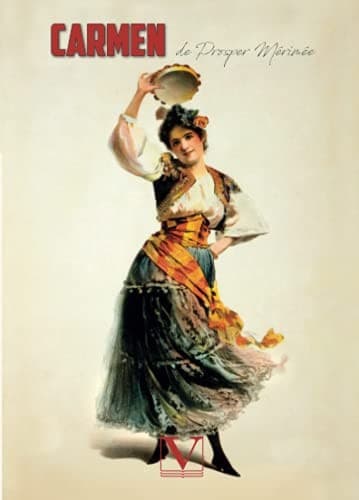
Carmen (Fictitious character) -- Fiction; Spain -- Social life and customs -- 19th century -- Fiction
“A mere savage prejudice,” said I to myself. “I shall have to answer for
all the crimes this brigand may commit in future.” Yet is that instinct
of the conscience which resists every argument really a prejudice? It
may be I could not have escaped from the delicate position in which I
found myself without remorse of some kind. I was still tossed to and
fro, in the greatest uncertainty as to the morality of my behaviour,
when I saw half a dozen horsemen ride up, with Antonio prudently lagging
behind them. I went to meet them, and told them the brigand had fled
over two hours previously. The old woman, when she was questioned by the
sergeant, admitted that she knew Navarro, but said that living alone,
as she did, she would never have dared to risk her life by informing
against him. She added that when he came to her house, he habitually
went away in the middle of the night. I, for my part, was made to ride
to a place some leagues away, where I showed my passport, and signed a
declaration before the _Alcalde_. This done, I was allowed to recommence
my archaeological investigations. Antonio was sulky with me; suspecting
it was I who had prevented his earning those two hundred ducats.
Nevertheless, we parted good friends at Cordova, where I gave him as
large a gratuity as the state of my finances would permit.
CHAPTER II
I spent several days at Cordova. I had been told of a certain manuscript
in the library of the Dominican convent which was likely to furnish me
with very interesting details about the ancient Munda. The good fathers
gave me the most kindly welcome. I spent the daylight hours within their
convent, and at night I walked about the town. At Cordova a great many
idlers collect, toward sunset, in the quay that runs along the right
bank of the Guadalquivir. Promenaders on the spot have to breathe the
odour of a tan yard which still keeps up the ancient fame of the country
in connection with the curing of leather. But to atone for this, they
enjoy a sight which has a charm of its own. A few minutes before the
Angelus bell rings, a great company of women gathers beside the river,
just below the quay, which is rather a high one. Not a man would dare
to join its ranks. The moment the Angelus rings, darkness is supposed to
have fallen. As the last stroke sounds, all the women disrobe and step
into the water. Then there is laughing and screaming and a wonderful
clatter. The men on the upper quay watch the bathers, straining
their eyes, and seeing very little. Yet the white uncertain outlines
perceptible against the dark-blue waters of the stream stir the poetic
mind, and the possessor of a little fancy finds it not difficult to
imagine that Diana and her nymphs are bathing below, while he himself
runs no risk of ending like Acteon.
Public-domain text, read in full here on John Shaqi.
Reviews
Reviews
No reviews yet
Be the first to share your thoughts on this work.
Join the Discussion
Join the discussion
Sign in to leave a comment or review.
Sign InorCreate an account