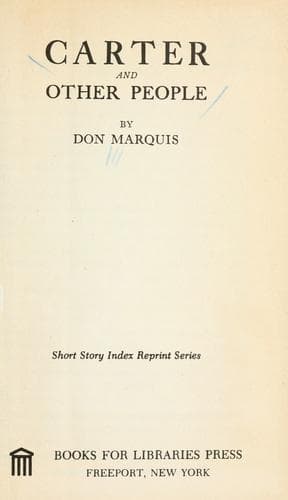
American fiction -- 20th century; Short stories, American
Carter began to learn that he was a nigger very early in life. Nigger
children are not left long in doubt anywhere, and especially in the
South. Carter first saw the light--and the shadows--of day in Atlanta.
The color line itself, about which one hears so much talk, seemed to run
along one end of the alley in which he was born. It was an alley with a
gutter and a great deal of mud in it. At the corner, where it gave into
a little narrow street not much better than an alley itself, the mud was
the thickest, deepest, and best adapted to sculptural purposes. But in
the little street lived a number of white families. They were most
of them mill hands, and a numerous spawn of skinny children, little
“crackers,” with faces white and sad even from babyhood, disputed the
mud with the nigger children. Nigger babies of five, four, three, and
even two, understood quite well that this most desirable mud, even
though it was in the nigger alley, was claimed by the white babies as
_their_ mud. It was in every way a more attractive sort of mud than
any in the little street proper; and juvenile race riots were of almost
hourly occurrence--skirmishes in which the very dogs took part. For the
dogs grasped the situation as clearly as did the children; a “nigger”
dog, even though he may have started in life as a white man's dog, soon
gets a certain look about him.
So there was no chance for Carter to escape the knowledge that he was
a nigger. But it was with a thrill that he perceived in his youthful
excursions from the home alley, that he was sometimes mistaken for a
white child. He was so white in color that one could not tell he was a
nigger at a casual glance.
As he grew up, he made another discovery that elated and embittered him
still more. He found out who his father was--or rather, who his father
had been, since he never saw that gentleman. The white blood in Carter's
veins was no common ichor. Because white people seldom speak of these
things it does not follow that they are not known pretty generally among
the negroes. They are, in fact, discussed.
Carter went to school; he made the further discovery that he had
brains--“white man's brains” is the way he put it to himself. Given the
opportunity, he told himself, he could go as far as the average white
man--perhaps further than the average. The white man's standard, nigger
though he was, was still the standard by which he must measure himself.
But the opportunity! Even as the youth prepared himself for it he
perceived, hopelessly, that it would be denied him.
Public-domain text, read in full here on John Shaqi.
Reviews
Reviews
No reviews yet
Be the first to share your thoughts on this work.
Join the Discussion
Join the discussion
Sign in to leave a comment or review.
Sign InorCreate an account