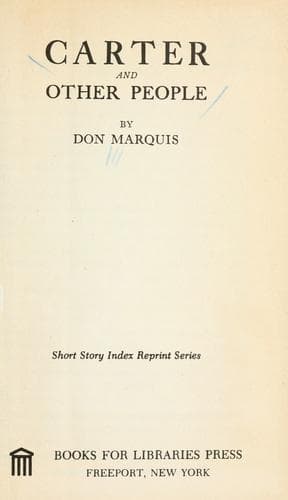
American fiction -- 20th century; Short stories, American
As he matured he began to feel a strange, secret pride in that
white family whose blood he shared. He familiarized himself with its
genealogy. There is many a courtier who cannot trace his ancestry as
far back as Carter could. One of his forebears had signed Magna Charta;
several had fought in the Revolutionary War. There had been a United
States Senator in the family, and a Confederate General. At times,
feeling the vigorous impulse of hereditary instinct and ambitions,
Carter looked upon himself as all white man, but never for long, nor to
any purpose. The consciousness of his negro blood pulled him down again.
But, as he grew up, he ceased to herd with black negroes; he scorned
them. He crept about the world cursing it and himself--an unfortunate
and bitter creature that had no place; unfortunate and bitter, cursed
with an intellect, denied that mitigation that might have come with a
full share of the negro jovialty of disposition, forever unreconciled.
There was one member of that white family from which he drew so much of
his blood whom Carter particularly admired. Willoughby Howard was about
Carter's own age, and he was Carter's half-brother. Howard did not
distinguish Carter from any other mulatto; probably did not know of his
existence. But as Howard reached manhood, and, through virtue of his
wealth and standing and parts, began to attain an excellent place in
the world, his rise was watched by Carter with a strange intensity of
emotion. Carter in some occult way identified himself with the career of
Willoughby Howard--sometimes he almost worshiped Willoughby Howard,
and then he hated him; he envied him and raged over him with the same
breath.
But mostly, as the isolation of his own condition, ate into his soul,
he raged over himself; he pitied himself; he hated himself. Out of the
turmoil of his spirit arose the one despairing cry, Oh, to be white,
white, _white!_
Many a night he lay awake until daybreak, measuring the slow minutes
with the ceaseless iteration of that useless prayer: Only to be white! O
God, for _one little year of being white!_
Fruitless hours of prayers and curses!
Carter went North. He went to New York. But the North, which affects to
promise so much to the negro, in a large, loose, general way, does not
perform in the same degree. There was only one thing which Carter would
have thanked any one for performing; it was the one thing that could
never be performed--he wanted to be made white. Sometimes, indeed, from
the depths of his despair, he cried out that he wanted to be altogether
black; but in his soul he did not really want that.
Public-domain text, read in full here on John Shaqi.
Reviews
Reviews
No reviews yet
Be the first to share your thoughts on this work.
Join the Discussion
Join the discussion
Sign in to leave a comment or review.
Sign InorCreate an account