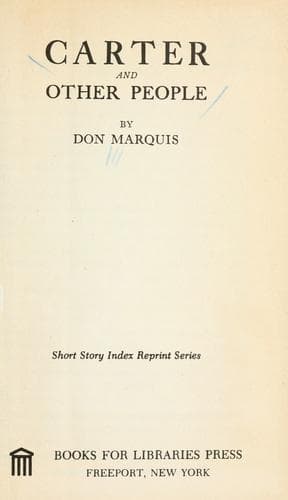
American fiction -- 20th century; Short stories, American
“I ought to tell you,” he said--and as he said it, staring out to sea,
he was so imposed upon by the importance of the moment to himself that
he almost felt as if the sea listened and the waves paused--“I ought to
tell you that I have negro blood in my veins.”
She was silent. There was a moment before he dared look at her; he could
not bear to read his doom in her eyes. But finally he did muster up
courage enough to turn his head.
The girl was placidly chewing gum and gazing at an excursion vessel that
was making a landing at one of the piers.
He thought she had not heard. “Mary,” he repeated, “I have negro blood
in my veins.”
“Uh-huh,” said she. “I gotcha the first time, Steve! Say, I wonder if we
couldn't take the boat back to town? Huh? Whatcha say?”
He looked at her almost incredulous. She had understood, and yet she
had not shrunk away from him! He examined her with a new interest; his
personal drama, in which she, perforce, must share, seemed to have made
no impression upon her whatsoever.
“Do you mean,” he said, hesitatingly, “that it will--that it won't make
any difference to you? That you can marry me, that you _will_ marry me,
in spite of--of--in spite of what I am?”
“Gee! but ain't you the solemn one!” said the girl, taking hold of her
gum and “stringing” it out from her lips. “Whatcha s'pose I care for a
little thing like that?”
He had looked for a sort of dramatic “situation”; and, behold, there was
none! There was none simply because the girl had no vantage point from
which to look at his life and hers. He had negro blood in his veins--and
she simply did not care one way or the other!
He felt no elation, no exultation; he believed that she _should_ have
cared; whether her love was great enough to pardon that in him or not,
she should have felt it as a thing that _needed_ pardon.
As he stared at the girl, and she continued to chew her gum, he swiftly
and subtly revised his estimate of her; and in his new appraisement
there was more than a tinge of disgust. And for a moment he became
altogether a white man in his judgment of the thing that was happening;
he looked at the situation as a patrician of the South might have looked
at it; the seven eighths of his blood which was white spoke:
“By God!” he said, suddenly leaping to his feet and flinging aside the
startled hand which the girl put out toward him, “I can't have anything
to do with a woman who'd marry a nigger!”
So Carter went back to Atlanta. And, curiously enough, he stepped from
the train almost into the midst of a strange and terrible conflict of
which the struggle in his individual breast was, in a sense, the type
and the symbol.
It was a Saturday night in September, an evening on which there began
a memorable and sanguinary massacre of negroes; an event which has been
variously explained and analyzed, but of which, perhaps, the underlying
causes will never be completely understood.
Public-domain text, read in full here on John Shaqi.
Reviews
Reviews
No reviews yet
Be the first to share your thoughts on this work.
Join the Discussion
Join the discussion
Sign in to leave a comment or review.
Sign InorCreate an account