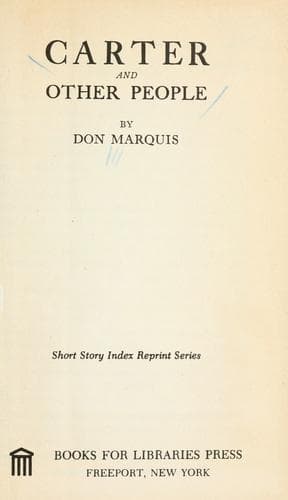
American fiction -- 20th century; Short stories, American
Nevertheless, at several different periods he yielded to temptation
and “went over to the whites.” In the South he could not have done
this without discovery, in spite of the color of his skin. But in the
Northern cities, with their enormous numbers of aliens, all more or less
strange to the American eye, Carter found no great difficulty in passing
as white. He “looked a little foreign” to the casual glance; that was
all.
But if there was no great difficulty in it, there was no great
satisfaction in it, either. In fact, it only made him the more bitter.
Others might think him a white man, but he knew that he was a nigger.
The incident which sent him back South, resolved to be a nigger, and to
live and die among the niggers, might not have affected another in his
condition just as it did Carter. But to him it showed conclusively that
his destiny was not a matter of environment so much as a question of
himself.
He fell in love. The girl was a waitress in a cheap restaurant near the
barber shop where Carter worked. She was herself a product of the
East Side, struggling upward from the slums; partly Italian, with some
Oriental strain in her that had given the least perceptible obliqueness
to her eyes--one of those rare hybrid products which give the thinker
pause and make him wonder what the word “American” will signify a
century from now; a creature with very red lips and very black eyebrows;
she seemed to know more than she really did; she had a kind of naïve
charm, a sort of allurement, without actual beauty; and her name had
been Anglicized into Mary.
And she loved Carter. This being, doomed from the cradle to despair, had
his moment of romance. But even in his intoxication there was no hope;
his elation was embittered and perplexed. He was tempted not to tell the
girl that he was a nigger. But if he married her, and did not tell her,
perhaps the first child would tell her. It might look more of a nigger
than he did.
But if he told her, would she marry a nigger? He decided he would tell
her. Perhaps his conscience had less to do with this decision than the
fatalism of his temperament.
So he made his revelation one Sunday evening, as they walked along the
boardwalk from Coney Island to Brighton. To him, it was a tremendous
moment. For days he had been revolving in his mind the phrases he
would use; he had been rehearsing his plea; in his imagination he saw
something spectacular, something histrionic, in his confession.
“Mary,” he said, as they sat down on a bench on the beach, “there is
something I think I ought to tell you before we get married.”
The girl turned toward him her big, sleepy, dark eyes, which always
seemed to see and understand so much more than they really did, and
looked away again.
Public-domain text, read in full here on John Shaqi.
Reviews
Reviews
No reviews yet
Be the first to share your thoughts on this work.
Join the Discussion
Join the discussion
Sign in to leave a comment or review.
Sign InorCreate an account