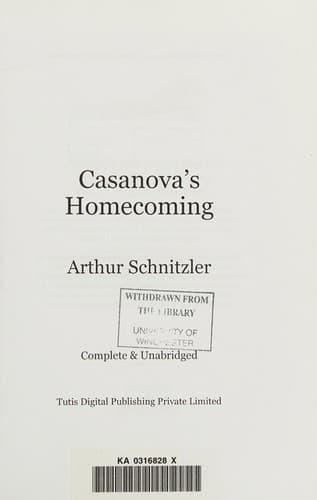
Adventure stories; Biographical fiction; Casanova, Giacomo, 1725-1798 -- Fiction; Europe -- Fiction; Sex customs -- Fiction
Casanova was disappointed. In such cases, whether he was relating a
dream or giving an account of real incidents, it was his way to
round off the narrative, attempting to convey a meaning. He remarked
discontentedly: “How strangely everything is distorted in dreams. Fancy,
that I should be wealthy; and that Lorenzi should be a beggar, and old!”
“As far as Lorenzi is concerned,” interjected Olivo, “there is not much
wealth about him. His father is fairly well off, but no one can say that
of the son.”
Casanova had no need to ask questions. He was speedily informed that
it was through the Marchese that they had made the Lieutenant’s
acquaintance. The Marchese had brought Lorenzi to the house only a few
weeks before. A man of the Chevalier’s wide experience would hardly
need prompting to enlighten him as to the nature of the young officer’s
relationship to the Marchesa. After all, if the husband had no
objection, the affair was nobody else’s business.
“I think, Olivo,” said Casanova, “that you have allowed yourself to be
convinced of the Marchese’s complaisance too easily. Did you not notice
his manner towards the young man, the mingling of contempt and ferocity?
I should not like to wager that all will end well.”
Marcolina remained impassive. She seemed to pay no attention to this
talk about Lorenzi, but sat with unruffled countenance, and to all
appearance quietly delighting in the landscape. The road led upwards by
a gentle ascent zigzagging through groves of olives and holly trees.
Now they reached a place where the horses had to go more slowly, and
Casanova alighted to stroll beside the carriage. Marcolina talked of
the lovely scenery round Bologna, and of the evening walks she was
in the habit of taking with Professor Morgagni’s daughter. She also
mentioned that she was planning a journey to France next year, in
order to make the personal acquaintance of Saugrenue, the celebrated
mathematician at the university of Paris, with whom she had
corresponded. “Perhaps,” she said with a smile, “I may look in at Ferney
on the way, in order to learn from Voltaire’s own lips how he has
been affected by the polemic of the Chevalier de Seingalt, his most
formidable adversary.”
Casanova was walking with a hand on the side of the carriage, close to
Marcolina’s arm. Her loose sleeve was touching his fingers. He answered
quietly: “It matters less what M. Voltaire thinks about the matter
than what posterity thinks. A final decision upon the merits of the
controversy must be left to the next generation.”
“Do you really think,” said Marcolina earnestly, “that final decisions
can be reached in questions of this character?”
“I am surprised that you should ask such a thing, Marcolina. Though your
philosophic views, and (if the term be appropriate) your religious
views, seem to me by no means irrefutable, at least they must be firmly
established in your soul--if you believe that there is a soul.”
Public-domain text, read in full here on John Shaqi.
Reviews
Reviews
No reviews yet
Be the first to share your thoughts on this work.
Join the Discussion
Join the discussion
Sign in to leave a comment or review.
Sign InorCreate an account