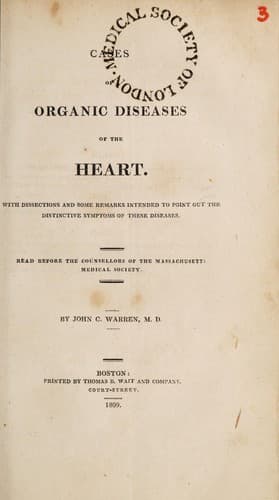
Cases of Organic Diseases of the Heart — John Shaqi
Cases of Organic Diseases of the HeartWarren, John Collins
Science
Cases of Organic Diseases of the Heart
Warren, John Collins
Heart -- Diseases
The bones of the cranium were unusually thick. The dura mater, which
was thickened, and in many places bore marks of former inflammation,
adhered to the bone at the vertex. On its internal surface, near the
longitudinal sinus, there was a small ossified portion, half an inch
long and the eighth of an inch thick. The convolutions of the brain
were narrow, and very strongly marked. The pia mater bore marks of
pretty extensive inflammation, and adhered to the dura mater at the
vertex. The cortical substance ran deep into the medullary part of
the brain. The ventricles contained about double the usual quantity of
water; their parts were all remarkably well defined. The vessels of
the pia mater, over the corpora striata, were unusually injected with
blood. The velum interpositum was very firm; the plexus choroides
uncommonly thick, but pale; the opening from the right to the left
ventricle large. The vessels of the brain were generally not much
filled with blood.
The blood appeared every where fluid, except in some portions of the
lungs, and in the cavities of the heart. It was very dark coloured,
perhaps more than ordinarily thin, and oozed from every part, which
was cut.
The cellular membrane, in all dependent parts, effused, when cut, a
serous fluid.
CASE II.
Mr. John Jackson, fifty-two years of age, had been affected for more
than two years with palpitations of the heart, and paroxysms of
dyspnœa. These symptoms increased in October, 1808, and were followed
by strong cough, uneasiness in lying down, sudden startings in sleep,
and an inclination to bend the body forward and to the left side. His
cough, during the last part of his life, was attended with copious
bloody expectoration. His countenance was florid; his pulse very
irregular, though not quite intermittent. The occasional variations in
the state of the disease were remarkable. Some periods were marked
with uncommon mental irritability. Pain in the region of the liver,
œdema of the inferior extremities, paucity and turbidness of the
urine, yellowness of the skin, and great emaciation attended the
latter stages of the disease. A degree of stupor occurred. The
termination on the 30th of January, 1809, was tolerably quiet. Two
days before death he sank into the recumbent posture, and his pulse
became more regular[5].
[Footnote 5: The symptoms of this patient were related by Dr.
Rand, sen. to whose politeness and love of medical
improvement I am indebted for the opportunity of examining
this and the following case.]
DISSECTION,
TWENTY-FOUR HOURS AFTER DEATH.
On opening the thorax, its right cavity was found to contain a large
quantity of water; the left, a smaller quantity.
The lungs were of a firm, condensed texture, especially at the lower
part, where their solidity was nearly equal to that of a healthy
liver. They contained black blood.
Public-domain text, read in full here on John Shaqi.
Reviews
Reviews
No reviews yet
Be the first to share your thoughts on this work.
Join the Discussion
Join the discussion
Sign in to leave a comment or review.
Sign InorCreate an account