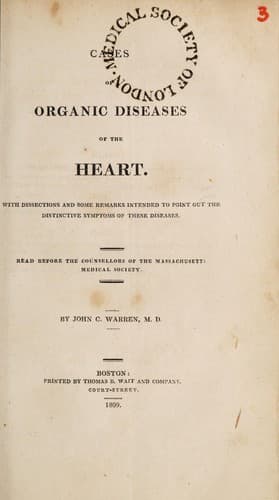
Cases of Organic Diseases of the HeartWarren, John Collins
Science
Cases of Organic Diseases of the Heart
Warren, John Collins
Heart -- Diseases
After the palpitations have lasted some time, a little difficulty of
breathing, accompanied with sighing, is perceived, especially on any
great exertion, ascending an eminence, or taking cold, of which there
is an uncommon susceptibility. This dyspnœa becomes, as it increases,
a most distressing symptom. It is induced by the slightest cause; as
by an irregularity in diet, emotions of the mind, and especially
movement of the body; so that on ascending stairs quickly, the patient
is threatened with immediate suffocation. It occurs at no stated
periods, but is never long absent, nor abates much in violence during
the course of the disease. It is attended with a sensation of
universal distress, which perhaps may arise from the circulation of
unoxygenated blood, or the accumulation of carbon in the system; for
the countenance becomes livid, and the skin, especially that of the
extremities, receives a permanent dark colour. This dyspnœa soon
causes distress in lying in an horizontal posture. The patient raises
his head in bed, gradually adding one pillow after another, till he
can rarely, in some cases never, lie down without danger of
suffocation; he inclines his head and breast forward, and supports
himself upon an attendant, or a bench placed before him. A few hours
before death the muscular power is no longer capable of maintaining
him in that posture, and he sinks backward. The dyspnœa is attended
with cough, sometimes through the whole of the disease, sometimes only
at intervals. The cough varies in frequency. It is always strong, and
commonly attended with copious expectoration of thick mucus, which, as
the disease advances, becomes brown coloured, and often tinged with
blood; a short time before death it frequently consists entirely of
black blood.
The changes in the phœnomena of the circulation are very remarkable.
The sanguiferous system is increased in capacity; the veins,
especially, are swelled with blood; the countenance is high coloured,
except in fits of dyspnœa, when it becomes livid; and it is very
frequently puffed, or turgid. The brightness of the eyes, dizziness,
which is a common, and head-ache, which is a frequent symptom, and in
some cases very distressing, are probably connected with these
changes. The motions of the heart, as has already been stated, are
inordinate, irregular, and tumultuous. The pulse presents many
peculiarities. In some cases, probably where there is no obstruction
in the orifices of the heart, it remains tolerably regular, and is
either hard, full, quick, vibrating and variable, or soft, slow,
compressible and variable. Most commonly, perhaps always, when the
orifices of the heart are obstructed, it is vibrating, very irregular,
very intermittent, sometimes contracted and almost imperceptible, very
variable, often disagreeing with the pulsations of the heart, and
sometimes differing in one of the wrists from the other.
Public-domain text, read in full here on John Shaqi.
Reviews
Reviews
No reviews yet
Be the first to share your thoughts on this work.
Join the Discussion
Join the discussion
Sign in to leave a comment or review.
Sign InorCreate an account