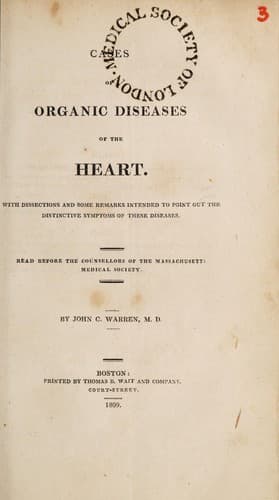
Cases of Organic Diseases of the HeartWarren, John Collins
Science
Cases of Organic Diseases of the Heart
Warren, John Collins
Heart -- Diseases
The functions of the brain suffer much disturbance. Melancholy, and a
disposition for reverie, attend the early stages of the complaint; and
there is sometimes an uncommon irritability of mind. The dreams become
frightful, and are interrupted by sudden starting up in terror.
Strange illusions present themselves. The mental faculties are
impaired. The termination of the disease is attended with slight
delirium; sometimes with phrenzy, and with hemiplegia.
The abdominal viscera are locally, as well as generally, affected.
Although the digestive functions are occasionally deranged, the
appetite is at some periods remarkably keen. The action of the
intestines is sometimes regular, but a state of costiveness is
common. The liver is often enlarged, probably from accumulation of
blood. This distention is attended with pain, varies much, and, in all
the cases I have seen, has subsided before death, leaving the coats of
the liver wrinkled, flaccid, and marked with appearances of
inflammation, caused by the distention and pressure against the
surrounding parts. An effect of the accumulation of blood in the
liver, and consequently in the mesenteric veins, is the frequent
discharge of blood from the hæmorrhoidal vessels. This occurs both in
the early and late stages of the disease, and may become a formidable
symptom. Evacuations of blood from the nose are not uncommon.
Dropsical swellings in various parts of the body succeed the symptoms
already enumerated. They commence in the cellular membrane of the
feet, and gradually extend up the legs and thighs; thence to the
abdominal cavity, to the thorax, sometimes to the pericardium, to the
face and superior extremities; and, lastly, to the ventricles and
meninges of the brain. These collections of water may be reabsorbed by
the aid of medicine; but they always return and attend, in some
degree, the patient’s death.
There is no circumstance more remarkable in the course of this
complaint, than the alternations of ease and distress. At one time the
patient suffers the severest agonies, assumes the most ghastly
appearance, and is apparently on the verge of death; in a day or a
week after, his pain leaves him, his appetite and cheerfulness
return, a degree of vigour is restored, and his friends forget that he
has been ill. The paroxysms occasionally recur, and become more
frequent, as the disease progresses. Afterwards the intermissions are
shorter, and a close succession of paroxysms begins. If the progress
of the complaint has been slow, and regular, the patient sinks into a
state of torpor, and dies without suffering great distress. If, on the
contrary, its progress has been rapid, the dyspnœa becomes excessive;
the pain and stricture about the præcordia are insupportable; a
furious delirium sometimes succeeds; and the patient expires in
terrible agony.
Such are the symptoms, which a limited experience has enabled me to
witness. Others, equally characteristic of the disease, may probably
exist.
Public-domain text, read in full here on John Shaqi.
Reviews
Reviews
No reviews yet
Be the first to share your thoughts on this work.
Join the Discussion
Join the discussion
Sign in to leave a comment or review.
Sign InorCreate an account