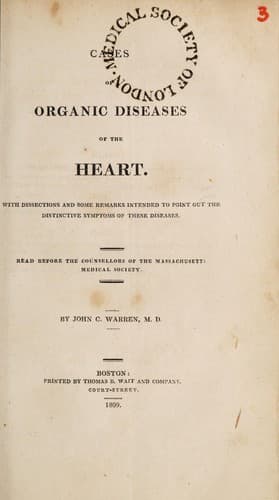
Cases of Organic Diseases of the HeartWarren, John Collins
Science
Cases of Organic Diseases of the Heart
Warren, John Collins
Heart -- Diseases
The left ventricle being thus dilated, the mitral valves
will not be able to completely cover its orifice, and part of the
blood will escape from the ventricle, when it contracts, into the
auricle when dilated with the blood from the lungs; and this undue
quantity of blood will gradually enlarge the auricle. A resistance
will arise, from the same cause, to the passage of the blood from the
lungs, thence to that from the right ventricle and auricle, and thus
these cavities may become enlarged in their turns. When an
ossification of the aorta, or of its valves, exists, there will be a
resistance to the passage of the blood from the left ventricle, either
by a loss of dilatability in the artery, or a contraction of the
orifice by the ossified parts. In either case, the blood will reflow
upon the heart, and dilate the left ventricle, as in _case the first_,
and others; and, if the mitral valves be thickened and rigid, the left
auricle will be more dilated than in a case of simple aneurism of the
left ventricle, as appeared also in the _first case_.
The coronary arteries, at their origin from the aorta, and a
considerable distance beyond, were ossified. How far does the
existence of this ossification in this and other cases related by
different authors, without symptoms of angina pectoris, disprove the
opinion that it is the cause of that disease?
The abdomen being opened, the organs generally appeared sound, except
the liver, which had its tunic inflamed, its substance indurated and
filled with blood. The vestiges of inflammation in the coat of the
liver were traced in every instance already related, while at the same
time the liver, in all, appeared shrunken. The diminution of size in
the liver, after death, cannot at present be well explained; for it is
very certain that such a diminution is not an attendant of this
disorder, during most of its stages, but that on the contrary a state
exists precisely opposed to it. The indications of distention of the
liver, clearly perceived in some cases, have been pain, tenderness,
and sense of distention, in the right hypochondrium, and, what is less
equivocal than these, very considerable swelling and prominence of the
liver. The inflammation of its tunic is an effect of this distention
and of the consequent pressure against the adjacent parts.
Public-domain text, read in full here on John Shaqi.
Reviews
Reviews
No reviews yet
Be the first to share your thoughts on this work.
Join the Discussion
Join the discussion
Sign in to leave a comment or review.
Sign InorCreate an account