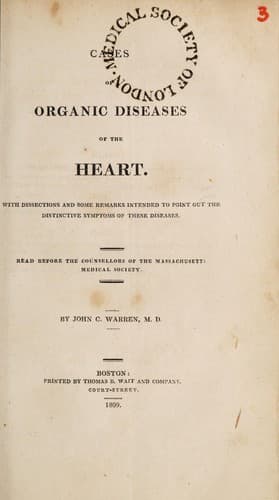
Cases of Organic Diseases of the HeartWarren, John Collins
Science
Cases of Organic Diseases of the Heart
Warren, John Collins
Heart -- Diseases
The cause of this phœnomenon can easily be explained. If an
obstruction exist in either side of the heart, or in the lungs, the
blood to be poured into the right auricle, from the vena cava
inferior, must be obstructed, its flow into that vessel from the liver
will be equally checked, the thin coats of the hepatic veins and of
the branches of the vena porta will yield and distend the soft
substance of the liver. Hence are caused the discharges of blood from
the hæmorrhoidal veins, which form one of the characteristic symptoms
of the disease; for as these vessels empty their blood into the
meseraic veins, which open into the vena porta, if the meseraic veins
be obstructed, the hæmorrhoidals must consequently be also affected,
and they easily burst open from too great distention. The hæmoptoe,
which also is so frequent, is as easily explained on the same
principle.
The cause of the serous collections is not so readily discovered. In
this case, as in most of the others, we found a considerable quantity
of water in the abdominal cavity. Dropsy is commonly considered as a
disease of debility, but in these cases it often appeared, while the
strength was unimpaired, and the heart acted with very extraordinary
force. If the blood was driven with rapidity through the arteries,
while an obstruction existed at the termination of the venous system
in the heart, the consequences must have been accumulation in the
venous system, difficult transmission of the blood from the extreme
arteries to the veins, overcharge of the arterial capillary system,
consequent excitement of the exhalant system to carry off the serous
part of the blood, for which it is adapted, and thence a serous
discharge into the cavities, and also on the surface of the body; for
great disposition to sweating is a common symptom. In addition to
these, there is another cause of the universality of these effusions.
The blood, in all the cases which I have examined, is both before and
after death, more thin and watery than healthy blood. How this
happens, our knowledge of the theory of sanguification does not enable
us to determine. Perhaps, as the imperfect respiration must cause a
deficiency of air, and consequently of oxygen, in the lungs; and as
the absorption of oxygen is a cause of solidity in many bodies, this
tenuity of the blood may proceed from a deficient absorption of
oxygen. However this may be, it is certain that the blood is very much
attenuated, though with considerable variations in degree, as it is
sometimes found thin on opening a vein, and at a subsequent period is
thicker; varying perhaps according to the continuance of ease or
difficulty in respiration. It is certain, that this attenuation of the
blood must tend to an increase of the serous exhalations.
Public-domain text, read in full here on John Shaqi.
Reviews
Reviews
No reviews yet
Be the first to share your thoughts on this work.
Join the Discussion
Join the discussion
Sign in to leave a comment or review.
Sign InorCreate an account