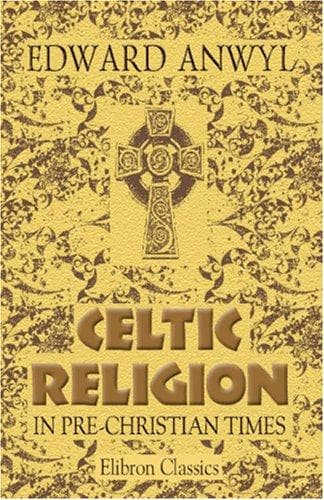
Celtic religion in pre-Christian times — John Shaqi
Celtic religion in pre-Christian timesAnwyl, E. (Edward)
Religion
Celtic religion in pre-Christian times
Anwyl, E. (Edward)
Celts -- Religion; Mythology, Celtic
In the preceding chapter we have seen that the belief was widely
prevalent among Greek and Roman writers that the Druids taught the
immortality of the soul. Some of these writers, too, point out the
undoubted fact, attested by Archaeology, that objects which would be
serviceable to the living were buried with the dead, and this was
regarded as a confirmation of the view that the immortality of souls was
to the Celts an object of belief. The study of Archaeology on the one
hand, and of Comparative Religion on the other, certainly leads to the
conclusion that in the Bronze and the Early Iron Age, and in all
probability in the Stone Age, the idea prevailed that death was not the
end of man. The holed cromlechs of the later Stone Age were probably
designed for the egress and ingress of souls. The food and the weapons
that were buried with the dead were thought to be objects of genuine
need. Roman religion, too, in some of its rites provided means for the
periodical expulsion of hungry and hostile spirits of the dead, and for
their pacification by the offer of food. A tomb and its adjuncts were
meant not merely for the honour of the dead, but also for the protection
of the living. A clear line of distinction was drawn between satisfied
and beneficent ghosts like the Manes, and the unsatisfied and hostile
ghosts like the Lemures and Larvae. To the Celtic mind, when its
analytical powers had come to birth, and man was sufficiently
self-conscious to reflect upon himself, the problem of his own nature
pressed for some solution. In these solutions the breath, the blood, the
name, the head, and even the hair generally played a part, but these
would not in themselves explain the mysterious phenomena of sleep, of
dreams, of epilepsy, of madness, of disease, of man's shadow and his
reflection, and of man's death. By long familiarity with the scientific
or quasi-scientific explanations of these things, we find it difficult to
realise fully their constant fascination for early man, who had his
thinkers and philosophies like ourselves. One very widely accepted
solution of early man in the Celtic world was, that within him there was
another self which could live a life of its own apart from the body, and
which survived even death, burial, and burning. Sometimes this inner
self was associated with the breath, whence, for example, the Latin
'anima' and the Welsh 'enaid,' both meaning the soul, from the root _an_-,
to breathe. At other times the term employed for the second self had
reference to man's shadow: the Greek 'skia,' the Latin 'umbra,' the Welsh
'ysgawd,' the English 'shade.' There are abundant evidences, too, that
the life-principle was frequently regarded as being especially associated
with the blood. Another tendency, of which Principal Rhys has given
numerous examples in his Welsh folk-lore, was to regard the soul as
capable of taking a visible form, not necessarily human, preferably that
of some winged creature.
Public-domain text, read in full here on John Shaqi.
Reviews
Reviews
No reviews yet
Be the first to share your thoughts on this work.
Join the Discussion
Join the discussion
Sign in to leave a comment or review.
Sign InorCreate an account