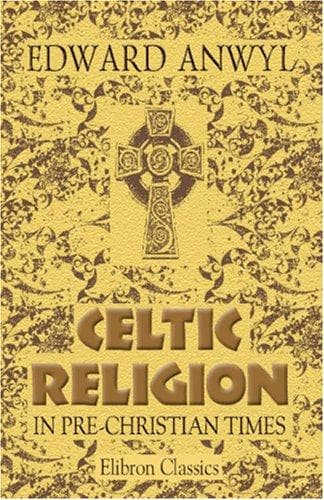
Celtic religion in pre-Christian timesAnwyl, E. (Edward)
Religion
Celtic religion in pre-Christian times
Anwyl, E. (Edward)
Celts -- Religion; Mythology, Celtic
In ancient writers there is no information as
to the views prevalent among the Celts regarding the forms or the abodes
of the spirits of the dead, beyond the statement that the Druids taught
the doctrine of their re-birth. We are thus compelled to look to the
evidence afforded by myth, legend, and folk-lore. These give fair
indications as to the types of earlier popular belief in these matters,
but it would be a mistake to assume that the ideas embodied in them had
remained entirely unchanged from remote times. The mind of man at
certain levels is quite capable of evolving new myths and fresh folk-lore
along the lines of its own psychology and its own logic. The forms which
the soul could take doubtless varied greatly in men's opinions in
different districts and in different mental perspectives, but folk-lore
tends to confirm the view that early man, in the Celtic world as
elsewhere, tended to emphasise his conception of the subtlety and
mobility of the soul as contrasted with the body. Sooner or later the
primitive philosopher was bound to consider whither the soul went in
dreams or in death. He may not at first have thought of any other sphere
than that of his own normal life, but other questions, such as the home
of the spirits of vegetation in or under the earth, would suggest, even
if this thought had not occurred to him before, that the spirits of men,
too, had entrance to the world below. Whether this world was further
pictured in imagination depended largely on the poetic genius of any
given people. The folk-lore of the Celtic races bears abundant testimony
to their belief that beneath this world there was another. The 'annwfn'
of the Welsh was distinctly conceived in the folk-lore embodied in
mediaeval poetry as being 'is elfydd' (beneath the world). In mediaeval
Welsh legend, again, this lower world is regarded as divided into
kingdoms, like this world, and its kings, like Arawn and Hafgan in the
Mabinogi of Pwyll, are represented as being sometimes engaged in
conflict. From this lower world had come to man some of the blessings of
civilisation, and among them the much prized gift of swine. The lower
world could be even plundered by enterprising heroes. Marriages like
that of Pwyll and Rhiannon were possible between the dwellers of the one
world and the other. The other-world of the Celts does not seem,
however, to have been always pictured as beneath the earth. Irish and
Welsh legend combine in viewing it at times as situated on distant
islands, and Welsh folk-lore contains several suggestions of another
world situated beneath the waters of a lake, a river, or a sea. In one
or two passages also of Welsh mediaeval poetry the shades are represented
as wandering in the woods of Caledonia (Coed Celyddon). This was no
doubt a traditional idea in those families that migrated to Wales in post-
Roman times from Strathclyde. To those who puzzled over the fate of the
Public-domain text, read in full here on John Shaqi.
Reviews
Reviews
No reviews yet
Be the first to share your thoughts on this work.
Join the Discussion
Join the discussion
Sign in to leave a comment or review.
Sign InorCreate an account