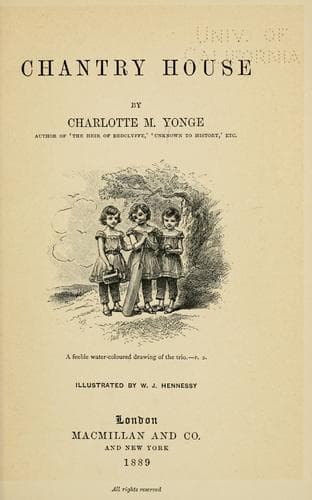
Domestic fiction; England -- Social life and customs -- 19th century -- Fiction; Family -- England -- Fiction
‘But when I lay upon the shore,
Like some poor wounded thing,
I deemed I should not evermore
Refit my wounded wing.
Nailed to the ground and fastened there,
This was the thought of my despair.’
ABP. TRENCH.
CLARENCE’S debut at the office was not wholly unsuccessful. He wrote a
good hand, and had a good deal of method and regularity in his nature,
together with a real sense of gratitude to Mr. Castleford; and this bore
him through the weariness of his new employment, and, what was worse, the
cold reception he met with from the other clerks. He was too quiet and
reserved for the wilder spirits, too much of a gentleman for others, and
in the eyes of the managers, and especially of the senior partner, a
disgraced, untrustworthy youth foisted on the office by Mr. Castleford’s
weak partiality. That old Mr. Frith had, Clarence used to say, a
perfectly venomous way of accepting his salute, and seemed always
surprised and disappointed if he came in in time, or showed up correct
work. Indeed, the old man was disliked and feared by all his
subordinates as much as his partner was loved; and while Mr. Castleford,
with his good-natured Irish wife and merry family, lived a life as
cheerful as it was beneficent, Mr. Frith dwelt entirely alone, in rooms
over the office, preserving the habits formed when his income had been
narrow, and mistrusting everybody.
At the end of the first month of experiment, Mr. Castleford declared
himself contented with Clarence’s industry and steadiness, and permanent
arrangements were made, to which Clarence submitted with an odd sort of
passive gratitude, such as almost angered my father, who little knew how
trying the position really was, nor how a certain home-sickness for the
seafaring life was tugging at the lad’s heart, and making each morning’s
entrance at the counting-house an effort—each merchant-captain, redolent
of the sea, an object of envy. My mother would have sympathised here,
but Clarence feared her more than my father, and she was living in
continual dread of some explosion, so that her dark curls began to show
streaks of gray, and her face to lose its round youthfulness.
Lent brought the question of Confirmation. Under the influence of good
Bishop Blomfield, and in the wave of evangelical revival—then at its
flood height—Confirmation was becoming a more prominent subject with
religious people than it had probably ever been in our Church, and it was
recognised that some preparation was desirable beyond the power of
repeating the Church Catechism. This was all that had been required of
my father at Harrow. My mother’s godfather, a dignified clergyman, had
simply said, ‘I suppose, my dear, you know all about it;’ and as for the
Admiral, he remarked, ‘Confirmed! I never was confirmed anything but a
post-captain!’
Public-domain text, read in full here on John Shaqi.
Reviews
Reviews
No reviews yet
Be the first to share your thoughts on this work.
Join the Discussion
Join the discussion
Sign in to leave a comment or review.
Sign InorCreate an account