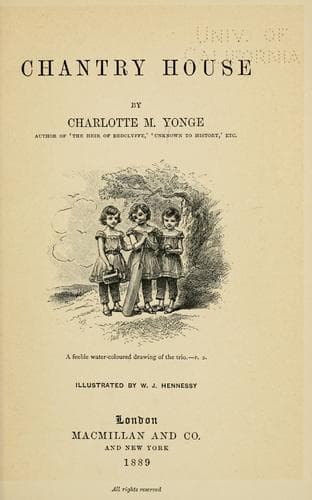
Domestic fiction; England -- Social life and customs -- 19th century -- Fiction; Family -- England -- Fiction
‘Helping you now to take it to papa in the study and explain!’ I cried;
but the struggle in that tall fellow was as if he had been seven years
old instead of seventeen, ere he put his hand over his face and gave me
his arm to come out into the hall, fetch the paper, and make his
confession. Alas! we were too late. The coat had been moved, the paper
had fallen out; and there stood my mother with it in her hand, looking at
Clarence with an awful stony face of mute grief and reproach, while he
stammered forth what he had said before, and that he was about to give it
to my father. She turned away, bitterly, contemptuously indignant and
incredulous; and my corroborations only served to give both her and my
father a certain dread of Clarence’s influence over me, as though I had
been either deceived or induced to back him in deceiving them. The
unlucky incident plunged him back into the depths, just as he had begun
to emerge. Slight as it was, it was no trifle to him, in spite of
Griffith’s exclamation, ‘How absurd! Is a fellow to be bound to give an
account of everything he looks at as if he were six years old? Catch me
letting my mother pry into my pockets! But you are too meek, Bill; you
perfectly invite them to make a row about nothing!’
CHAPTER VII.
THE INHERITANCE.
‘For he that needs five thousand pound to live
Is full as poor as he that needs but five.
But if thy son can make ten pound his measure,
Then all thou addest may be called his treasure.’
GEORGE HERBERT.
IT was in the spring of 1829 that my father received a lawyer’s letter
announcing the death of James Winslow, Esquire, of Chantry House,
Earlscombe, and inviting him, as heir-at-law, to be present at the
funeral and opening of the will. The surprise to us all was great. Even
my mother had hardly heard of Chantry House itself, far less as a
possible inheritance; and she had only once seen James Winslow. He was
the last of the elder branch of the family, a third cousin, and older
than my father, who had known him in times long past. When they had last
met, the Squire of Chantry House was a married man, with more than one
child; my father a young barrister; and as one lived entirely in the
country and the other in town, without any special congeniality, no
intercourse had been kept up, and it was a surprise to hear that he had
left no surviving children. My father greatly doubted whether being
heir-at-law would prove to avail him anything, since it was likely that
so distant a relation would have made a will in favour of some nearer
connection on his wife’s or mother’s side. He was very vague about
Chantry House, only knowing that it was supposed to be a fair property,
and he would hardly consent to take Griffith with him by the Western
Royal Mail, warning him and all the rest of us that our expectations
would be disappointed.
Public-domain text, read in full here on John Shaqi.
Reviews
Reviews
No reviews yet
Be the first to share your thoughts on this work.
Join the Discussion
Join the discussion
Sign in to leave a comment or review.
Sign InorCreate an account