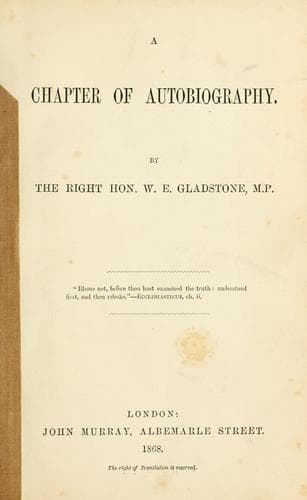
Chapter of AutobiographyGladstone, W. E. (William Ewart)
Religion
Chapter of Autobiography
Gladstone, W. E. (William Ewart)
Church of Ireland -- Establishment and disestablishment; Gladstone, W. E. (William Ewart), 1809-1898
And further. The Liberal Government and party of that day proposed,
in 1835 and the following years, the famous "Appropriation Clause."
The principle of their measure was, that the surplus funds only of
the Irish Church were to be applied to popular education, after
adequate provision had been made for the spiritual wants of the
Protestants. This principle, that adequate provision is to be made for
the spiritual wants of the Protestants, before any other claim on the
property of the Irish Church can be admitted, was the basis of the
Appropriation Clause; and is, as I understand the matter, the very
principle which is now maintained against the Liberal party of 1868,
by the (so-called) defenders of the Irish Established Church. But this
principle I denounced in 1836 as strongly as I could now do. I extract
the following passage from a report in 'Hansard,' which, as I remember,
I had myself corrected, of a speech on the Irish Tithe Bill with the
Appropriation Clause:--[6]
"A Church Establishment is maintained either for the
sake of its members or its doctrines; for those whom it
teaches, or for that which it teaches. On the former
ground it is not in equity tenable for a moment.
"Why should any preference be given to me over another
fellow-subject, or what claim have I personally to have
my religion supported, whilst another is disavowed by
the State? No claim whatever in respect to myself. I
concur entirely with gentlemen opposite, hostile to an
Establishment, that no personal privilege ought in such a
matter to be allowed.
"But if, on the contrary, I believe, as the great bulk of
the British Legislature does believe, that the doctrine
and system of the Establishment contain and exhibit truth
in its purest and most effective form, and if we also
believe truth to be good for the people universally,
then we have a distinct and immovable ground for the
maintenance of an Establishment; but it follows as a
matter of course from the principle, that it must be
maintained, not on a scale exactly and strictly adjusted
to the present number of its own members, but on such
a scale that it may also have the means of offering to
others the benefits which it habitually administers to
them.
Public-domain text, read in full here on John Shaqi.
Reviews
Reviews
No reviews yet
Be the first to share your thoughts on this work.
Join the Discussion
Join the discussion
Sign in to leave a comment or review.
Sign InorCreate an account