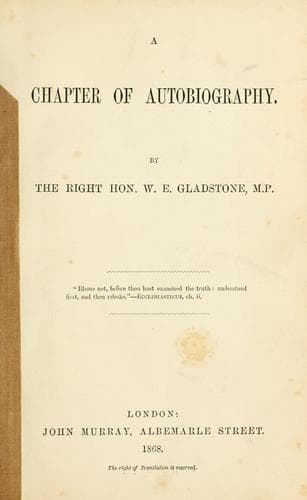
Chapter of AutobiographyGladstone, W. E. (William Ewart)
Religion
Chapter of Autobiography
Gladstone, W. E. (William Ewart)
Church of Ireland -- Establishment and disestablishment; Gladstone, W. E. (William Ewart), 1809-1898
"Therefore we wish to see the Establishment in Ireland
upheld; not for the sake of the Protestants, but of the
people at large, that the ministers may be enabled to use
the influences of their station, of kindly offices and
neighbourhood, of the various occasions which the daily
intercourse and habits of social life present; aye, and
I do not hesitate to add of persuasion itself, applied
with a zeal tempered by knowledge and discretion, in the
propagation of that which is true, and which, being true,
is good as well for those who as yet have it not, as
well for those who have it. It is the proposition of the
noble Lord which is really open to the charge of bigotry,
intolerance, and arbitrary selection; because, disavowing
the maintenance and extension of truth, he continues by
way of personal privilege to the Protestants the legal
recognition of their Church, which he refuses to the
Church of the Roman Catholic."
The negative part of this passage I adopt, except the censure it
implies upon Earl Russell and his friends; who, whether their actual
propositions were defensible or not, had the "root of the matter" in
their hearts, and were far ahead of me in their political forethought,
and in their desire to hold up at least the banner of a generous and a
hopeful policy towards Ireland.
In this manner I prove that, while I was bound by the propositions
of my work, I was not singly but doubly bound. I was bound to
defend the Irish Church, as long as it could be defended on the
ground of its truth. But when the day arrived on which that ground
was definitively abandoned, on which a policy was to be adopted by
the Imperial Parliament such as to destroy this plea for the Irish
Establishment, I was equally bound in such case to adopt no other: I
had shown that justice would fail to warrant the mere support of the
Church of the minority; I was held, therefore, not to construct out
of rags and tatters, shreds and patches, a new and different case for
maintaining it on the ground of favour, or, as it is termed, justice,
to Protestants; and, if I had done anything of this kind, I should not
have escaped the responsibility of inconsistency, but should simply
have added a second and (as I think) a less excusable inconsistency to
the first.
The day for the adoption of such a policy as I have described was not
far distant.
Public-domain text, read in full here on John Shaqi.
Reviews
Reviews
No reviews yet
Be the first to share your thoughts on this work.
Join the Discussion
Join the discussion
Sign in to leave a comment or review.
Sign InorCreate an account