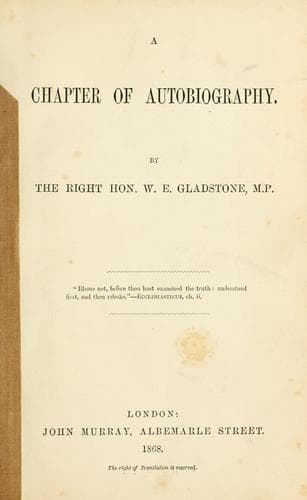
Chapter of AutobiographyGladstone, W. E. (William Ewart)
Religion
Chapter of Autobiography
Gladstone, W. E. (William Ewart)
Church of Ireland -- Establishment and disestablishment; Gladstone, W. E. (William Ewart), 1809-1898
True, I did not say that I was thenceforward prepared at any moment
to vote for the removal of the Established Church in Ireland. And
this for the best of all reasons: it would not have been true. It is
one thing to lift the anchor; it is another to spread the sails. It
may be a duty to be in readiness for departure, when departure itself
would be an offence against public prudence and public principle. But
I do not go so far even as this. On the contrary, I was willing and
desirous[9] that it should be permitted to continue. If its ground in
logic was gone, yet it might have, in fact, like much besides, its day
of grace. I do not now say that I leapt at once to the conclusion that
the Established Church of Ireland must at any definite period "cease
to exist as an Establishment." She had my sincere good will; I was not
sorry, I was glad, that while Ireland seemed content to have it so,
a longer time should be granted her to unfold her religious energies
through the medium of an active and pious clergy, which until this our
day she had never possessed. My mind recoiled then, as it recoils now,
from the idea of worrying the Irish Church to death. I desired that it
should remain even as it was, until the way should be opened, and the
means at hand, for bringing about some better state of things.
Moreover, it was a duty, from my point of view, completely to exhaust
every chance on behalf of the Irish Church. I have not been disposed,
at any time of life, gratuitously to undertake agitation of the most
difficult, and at times apparently the most hopeless questions. At
the period of the Appropriation Clause, I represented to myself, and
I believe to others, that the true power of the Church as a religious
engine had never up to that period been fairly tried. In name a
religious institution, her influences, her benefices, her sees, were
commonly employed for purposes, which we must condemn as secular, even
if they had not been utterly _anti-national_. Only within a few, a very
few years, had her clergy even begun to bestir themselves; and they had
forthwith found that, from the unsettled state of the law of tithe,
they were in the midst of an agitation, both menacing to public order,
and even perilous to life. I was desirous to see what, after person and
property should have been rendered secure, and a peaceful atmosphere
restored, a generation of pious and zealous men could accomplish in
their actual position. I am still of the opinion that thirty-five years
ago the religion of the Irish Church had not--to her and to our shame
be it spoken--had fair play. From the days of Elizabeth downwards, with
the rarest exceptions, the worldly element had entirely outweighed the
religious one (whatever the intention may have been) in the actual
working of the ecclesiastical institutions of Ireland. Mr. Burke has
immortalised the burning shame and the hideous scandals of those penal
laws which, perhaps for the first time in the history of Christendom if
Public-domain text, read in full here on John Shaqi.
Reviews
Reviews
No reviews yet
Be the first to share your thoughts on this work.
Join the Discussion
Join the discussion
Sign in to leave a comment or review.
Sign InorCreate an account