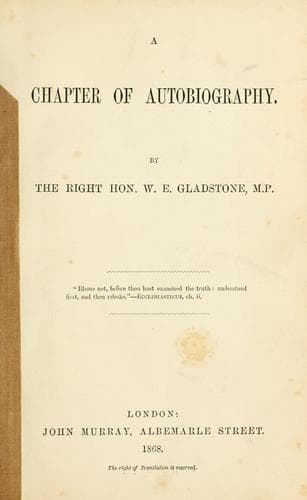
Chapter of AutobiographyGladstone, W. E. (William Ewart)
Religion
Chapter of Autobiography
Gladstone, W. E. (William Ewart)
Church of Ireland -- Establishment and disestablishment; Gladstone, W. E. (William Ewart), 1809-1898
not of man, aimed at persecuting men out of one religion, but not at
persecuting them into another. I will not be so rash as to enter on the
field--
"Per quem magnus equos Auruncæ flexit alumnus."
But the time of awakening had come. The Irish Church had grown
conscious that she had a Gospel to declare. Even with my present
opinions I might feel a scruple as to the measures now proposed, but
for the resistless and accumulated proof of impotence afforded by the
experience of my life-time, and due, I believe, to a radically false
position. For the Irish Church has, since the tithe war of 1830-2 came
to an end, had not only fair play--that is such fair play as in Ireland
the Establishment allows to the Church--but fair play and something
more. She has enjoyed an opportunity, extending over a generation of
men, with circumstances of favour such as can hardly be expected to
recur. What has been her case? She has had ample endowments; perfect
security; an almost unbroken freedom from the internal controversies
which have chastened (though, in chastening, I believe improved)
the Church of England. The knowledge of the Irish language has been
extensively-attained by her clergy.[10] She has had all the moral
support that could be given her by the people of this country; for it
was the people, and not a mere party, who, in 1835-8, repudiated and
repelled the Appropriation Clause. Her rival, the Church of Rome, has
seen its people borne down to the ground by famine; and then thinned
from year to year, in hundreds of thousands, by the resistless force
of emigration. And, last and most of all, in the midst of that awful
visitation of 1847-8, her Protestant Clergy came to the Roman Catholic
people clad in the garb of angels of light; for, besides their own
bounty (most liberal, I believe, in proportion to their means), they
became the grand almoners of the British nation. When, after all this,
we arrive at a new census of religion in 1861, we find that only the
faintest impression has been made upon the relative numbers of the two
bodies; an impression much slighter, I apprehend, than would have been
due to the comparative immunity of the Established Church from the
drain of emigration; and, if so, representing in reality, not a gain,
but a virtual loss of some part of the narrow ground which before was
occupied by the favoured religion of the State.
Public-domain text, read in full here on John Shaqi.
Reviews
Reviews
No reviews yet
Be the first to share your thoughts on this work.
Join the Discussion
Join the discussion
Sign in to leave a comment or review.
Sign InorCreate an account