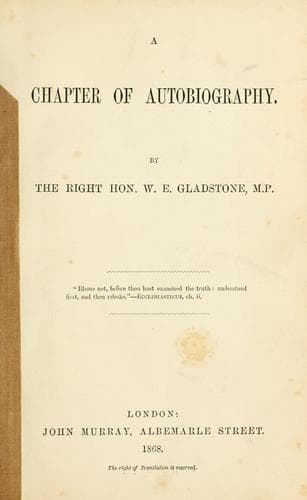
Chapter of AutobiographyGladstone, W. E. (William Ewart)
Religion
Chapter of Autobiography
Gladstone, W. E. (William Ewart)
Church of Ireland -- Establishment and disestablishment; Gladstone, W. E. (William Ewart), 1809-1898
I have described the erroneous impressions as to the actual and
prospective state of things, under which was urged the practical
application of that system of thought embodied in my work of 1838.
It may be said my error was a gross or even an absurd one. On that
question I need not enter. But I will endeavour to bring into view some
circumstances relating to the time, which may help to account for it.
And here I feel that I pass beyond the narrower and more personal scope
of these pages, if I attempt to recall some of the changes that have
taken place during the last thirty or five-and-thirty years, in matters
which bear upon the religious character and relations of the State.
At that time, Jews, and others not adopting the Christian name,
were excluded from civil office; and though Roman Catholics and
Nonconformists had effected an entrance into Parliament, there still
remained an oath for the former, and a declaration for the latter,
which, if they did not practically limit freedom, yet denoted, like the
mark of chains on the limbs of an emancipated slave, that there had
been a time when it did not exist. The Establishment of Scotland was
still entire, and animated with the strength principally of the eminent
men who afterwards led the Free Church Secession. The attack on the
Irish Church, pushed in 1835 with earnestness and vigour by the Liberal
party, had speedily proved to be hopeless. The State continued to make
to other persuasions certain grants, little more than compassionate,
and handed down from other times; but, even in the case of the classes
especially in its charge, such as soldiers and sailors, or such again
as paupers and criminals, it rarely permitted, and still more rarely
provided for them, the means of religious worship according to their
own religious convictions. In the great province of popular education
in England, nothing was granted except to schools of the Church, or to
schools in which, while the Bible was read, no religion other than that
of the Church was taught; and he would have been deemed something more
than a daring prophet, who should have foretold that in a few years the
utmost ambition of the lay champions, and of the spiritual heads of the
Church, would be to obtain the maintenance of a denominational system
in popular education, under which all religions alike should receive
the indirect, yet not unsubstantial, countenance of the State.
But the most important of all the changes which have taken place within
the interval, has been the change in the condition of the Church of
England itself.
Public-domain text, read in full here on John Shaqi.
Reviews
Reviews
No reviews yet
Be the first to share your thoughts on this work.
Join the Discussion
Join the discussion
Sign in to leave a comment or review.
Sign InorCreate an account