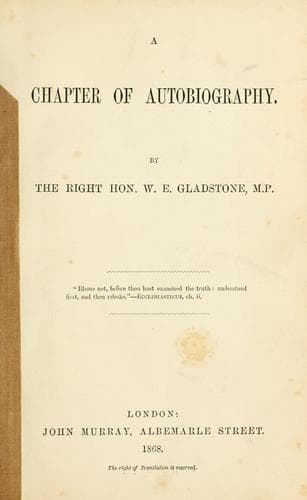
Chapter of AutobiographyGladstone, W. E. (William Ewart)
Religion
Chapter of Autobiography
Gladstone, W. E. (William Ewart)
Church of Ireland -- Establishment and disestablishment; Gladstone, W. E. (William Ewart), 1809-1898
Even for those old enough to have an adequate recollection of the
facts, it requires no inconsiderable mental effort to travel backwards
over the distractions, controversies, perils, and calamities of the
last thirty years, to the period immediately before those years; and
to realise not only the state of facts, but especially the promises
and prospects which it presented. I am well aware that any description
of it which may now be attempted will appear to bear more or less
the colour of romance; but, without taking it into view, no one can
either measure the ground over which we have travelled, or perceive how
strong was then the temptation to form an over-sanguine estimate of the
probable progress of the Church in her warfare with sin and ignorance,
and even in persuading seceders of all kinds to re-enter her fold.
That time was a time such as comes, after sickness, to a man in the
flower of life, with an unimpaired and buoyant constitution; the time
in which, though health is as yet incomplete, the sense and the joy of
health are keener, as the fresh and living current first flows in, than
are conveyed by its even and undisturbed possession.
The Church of England had been passing through a long period of deep
and chronic religious lethargy. For many years, perhaps for some
generations, Christendom might have been challenged to show, either
then or from any former age, a clergy (with exceptions) so secular and
lax, or congregations so cold, irreverent, and indevout. The process
of awakening had, indeed, begun many years before; but a very long
time is required to stir up effectually a torpid body, whose dimensions
overspread a great country. Active piety and zeal among the clergy,
and yet more among the laity, had been in a great degree confined
within the narrow limits of a party, which, however meritorious in
its work, presented in the main phenomena of transition, and laid but
little hold on the higher intellect and cultivation of the country.
Our churches and our worship bore in general too conclusive testimony
to a frozen indifference. No effort had been made either to overtake
the religious destitution of the multitudes at home, or to follow the
numerous children of the Church, migrating into distant lands, with
any due provision for their spiritual wants. The richer benefices were
very commonly regarded as a suitable provision for such members of the
higher families as were least fit to push their way in any profession
requiring thought or labour. The abuses of plurality and non-residence
were at a height, which, if not proved by statistical returns, it would
now be scarcely possible to believe. In the greatest public school of
the country (and I presume it may be taken as a sample of the rest) the
actual teaching of Christianity was all but dead, though happily none
of its forms had been surrendered. It is a retrospect full of gloom;
and with all our Romanising, and all our Rationalising, what man of
Public-domain text, read in full here on John Shaqi.
Reviews
Reviews
No reviews yet
Be the first to share your thoughts on this work.
Join the Discussion
Join the discussion
Sign in to leave a comment or review.
Sign InorCreate an account