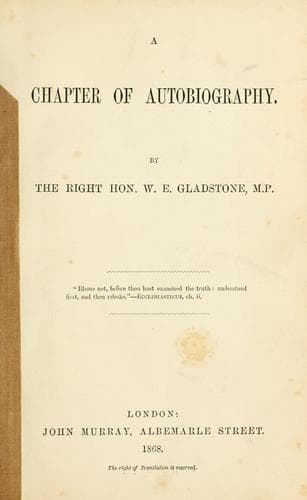
Chapter of AutobiographyGladstone, W. E. (William Ewart)
Religion
Chapter of Autobiography
Gladstone, W. E. (William Ewart)
Church of Ireland -- Establishment and disestablishment; Gladstone, W. E. (William Ewart), 1809-1898
and of universities, was steadily yet rapidly raised. The greatest
change of all was within the body of the clergy.[17] A devoted piety
and an unworldly life, which had been the rare exceptions, became
visibly from year to year more and more the rule. The spectacle, as
a whole, was like what we are told of a Russian spring: when, after
long months of rigid cold, almost in a day the snow dissolves, the ice
breaks up and is borne away, and the whole earth is covered with a rush
of verdure. These were bright and happy days for the Church of England.
She seemed, or seemed to seem, as a Church recalling the descriptions
of Holy Writ; to be "beautiful as the sun which goeth forth in his
might,"[18] "and terrible as an army with banners."[19]
Of this great renovating movement, a large part centred in Oxford. At
the time, indeed, when I resided there, from 1828 to 1831, no sign of
it had yet appeared. A steady, clear, but dry Anglican orthodoxy bore
sway, and frowned, this way or that, on the first indication of any
tendency to diverge from the beaten path. Dr. Pusey was, at that time,
revered, indeed, for his piety and charity, no less than admired for
his learning and talents, but suspected (I believe) of sympathy with
the German theology, in which he was known to be profoundly versed.
Dr. Newman was thought to have about him the flavour of what, he has
now told the world, were the opinions he had derived in youth from
the works of Thomas Scott. Mr. Keble, the "sweet singer of Israel,"
and a true saint, if this generation has seen one, did not reside in
Oxford.[20] The chief Chair of Theology had been occupied by Bishop
Lloyd, the old tutor and the attached and intimate friend of Peel: a
man of powerful talents, and of a character both winning and decided,
who, had his life been spared, might have acted powerfully for good
on the fortunes of the Church of England, by guiding the energetic
influences which his teaching had done much to form. But he had been
hurried away in 1829 by an early death: and Dr. Whately, who was also,
in his own way, a known power in the University, was in 1830 induced to
accept the Archbishopric of Dublin. There was nothing at that time in
the theology, or in the religious life, of the University to indicate
what was to come. But when, shortly afterwards, the great heart of
England began to beat with the quickened pulsations of a more energetic
religious life, it was in Oxford that the stroke was most distinct
and loud. An extraordinary change appeared to pass upon the spirit of
the place. I believe it would be a moderate estimate to say that much
beyond one half of the very flower of its youth chose the profession
of Holy Orders, while an impression scarcely less deep seemed to be
stamped upon a large portion of its lay pupils. I doubt whether at
any period of its existence, either since the Reformation, or perhaps
before it, the Church of England had reaped from either University, in
so short a time, so rich a harvest.
Public-domain text, read in full here on John Shaqi.
Reviews
Reviews
No reviews yet
Be the first to share your thoughts on this work.
Join the Discussion
Join the discussion
Sign in to leave a comment or review.
Sign InorCreate an account