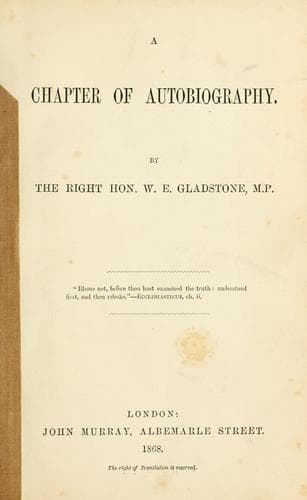
Chapter of AutobiographyGladstone, W. E. (William Ewart)
Religion
Chapter of Autobiography
Gladstone, W. E. (William Ewart)
Church of Ireland -- Establishment and disestablishment; Gladstone, W. E. (William Ewart), 1809-1898
sense would wish to go back upon those dreary times:
"Domos Ditis vacuas, et inania regna"?[16]
But between 1831 and 1840, the transformation, which had previously
begun, made a progress altogether marvellous. Much was due, without
doubt, to the earnest labour of individuals. Such men as Bishop
Blomfield on the Bench, and Dr. Hook in the parish (and I name them
only as illustrious examples), who had long been toiling with a
patient but a dauntless energy, began as it were to get the upper
hand. But causes of deep and general operation were also widely at
work. As the French Revolution had done much to renovate Christian
belief on the Continent, so the Church of England was less violently,
but pretty sharply, roused by the political events which arrived in a
rattling succession. In 1828, the repeal of the Test Act. In 1829, the
emancipation of the Roman Catholics. In 1831-2, the agony and triumph
of Reform. In 1833, the Church Temporalities Act for Ireland. There was
now a general uprising of religious energy in the Church throughout the
land. It saved the Church. Her condition before 1830 could not possibly
have borne the scrutinising eye, which for thirty years past has been
turned upon our institutions. Her rank corruptions must have called
down the avenging arm. But it was arrested just in time.
It would be difficult to give a just and full idea of the beneficial
changes which were either accomplished or begun during this notable
decade of years. They embraced alike formal, official movements, of
a nature to strike the general eye, and those local improvements in
detail, which singly are known only in each neighbourhood, but which
unitedly transform the face of a country. Laws were passed to repress
gross abuses, and the altering spirit of the clergy seconded and even
outstripped the laws. The outward face of divine worship began to be
renovated, and the shameful condition of the sacred fabrics was rapidly
amended, with such a tide of public approval as overflowed all the
barriers of party and of sect, and speedily found its manifestations
even in the seceding communions. There is no reason to doubt that at
that time at least, and before such changes had become too decidedly
the fashion, the outward embellishment of churches, and the greater
decency and order of services, answered to, and sprang from, a call
within, and proved a less unworthy conception of the sublime idea of
Christian worship. The missionary arm of the Church began to exhibit a
vigour wholly unknown to former years. Noble efforts were made, under
the auspices of the chief bishops of the Church, to provide for the
unsatisfied spiritual wants of the metropolis. The great scheme of the
Colonial Episcopate was founded; and, in its outset, led to such a
development of apostolic zeal and self-denial as could not but assist,
by a powerful reaction, the domestic progress. The tone of public
schools (on one of which Arnold was now spending his noble energies)
Public-domain text, read in full here on John Shaqi.
Reviews
Reviews
No reviews yet
Be the first to share your thoughts on this work.
Join the Discussion
Join the discussion
Sign in to leave a comment or review.
Sign InorCreate an account