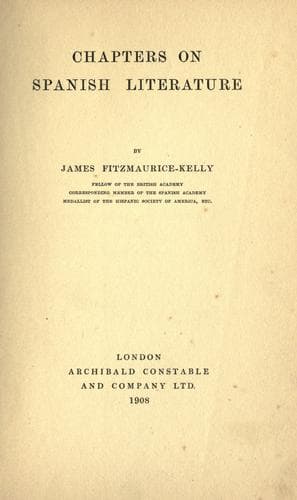
Chapters on Spanish LiteratureFitzmaurice-Kelly, James
History
Chapters on Spanish Literature
Fitzmaurice-Kelly, James
Spanish literature; Spanish literature -- History and criticism
It can scarcely be doubted that _Don Quixote_ contains many allusions
to contemporaries and contemporary events. We can catch the point of
his jests at Lope de Vega’s fondness for a classical reference, or at a
geographical blunder made by the learned Mariana; but probably many an
allusion of the same kind escapes us in Cervantes’s pages. The same may
be said of Shakespeare, and hence both Cervantes and Shakespeare have
been much exposed to the attentions of commentators. In a celebrated
passage of _A Midsummer-Night’s Dream_ Oberon addresses Puck:—
Thou rememberest
Since once I sat upon a promontory,
And heard a mermaid on a dolphin’s back
Uttering such dulcet and harmonious breath
That the rude sea grew civil at her song
And certain stars shot madly from their spheres,
To hear the sea-maid’s music.
An ordinary reader would be content to admire the lines as they stand,
but a commentator is an extraordinary reader, who feels compelled to
justify his existence by identifying the mermaid with Mary Queen of
Scots, the dolphin with her first husband the Dauphin of France, and
the certain stars with Mary’s English partisans. In precisely the same
way Don Quixote has been identified with the Duke of Lerma, Sancho
Panza with Pedro Franqueza, and the three ass-colts—promised by the
knight to the squire as some compensation for the loss of Dapple—have
been flatteringly recognised as the three Princes of Savoy, Philip,
Victor Amadeus, and Emmanuel Philibert. These identifications seem
quite as likely to be correct in the one case as in the other. We need
not discuss them. But if _A Midsummer-Night’s Dream_ and _Don Quixote_
were really intended as a couple of political pasquinades, they must be
classed as complete failures: the idea that Cervantes and Shakespeare
were a pair of party pamphleteers is a piece of grotesque perversity.
Apart from the matter of _Don Quixote_, the diversity of its manner
is arresting. Even those who most admire the elaborate diction of the
_Galatea_ are compelled to admit its monotony. The variety of incident
in _Don Quixote_ corresponds to a variety of style which is a new
thing in Spanish literature. Still there are examples of deliberate
imitation, not only in the travesties of the romances of chivalry, but
in such passages as Don Quixote’s famous declamation on the happier Age
of Gold:—
Public-domain text, read in full here on John Shaqi.
Reviews
Reviews
No reviews yet
Be the first to share your thoughts on this work.
Elsewhere in the archive
Join the Discussion
Join the discussion
Sign in to leave a comment or review.
Sign InorCreate an account