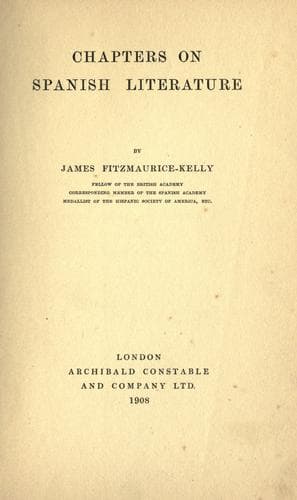
Chapters on Spanish LiteratureFitzmaurice-Kelly, James
History
Chapters on Spanish Literature
Fitzmaurice-Kelly, James
Spanish literature; Spanish literature -- History and criticism
Happy the age, happy the time, to which the ancients
gave the name of golden, not because in that fortunate
age the gold so coveted in this our iron one was gained
without labour, but because they that lived in it knew
not the two words ‘mine’ and ‘thine.’ In that blessed age
all things were in common; to win the daily food no toil
was needed from any man but to stretch out his hand and
pluck it from the mighty oaks that stood there generously
inviting him with their sweet ripe fruit. The crystal
streams and rippling brooks yielded their clear and
grateful waters in splendid profusion. The busy and wise
bees set up their commonwealth in the clefts of the rocks
and the hollows of the trees, offering without usance
to every hand the abundant produce of their fragrant
toil.... Fraud, deceit, or malice had not as yet tainted
truth and sincerity. Justice held her own, untroubled and
unassailed by the attempts of favour and interest, which
so greatly damage, corrupt, and encompass her about....
And so forth. It is a fine piece of embroidered rhetoric, which is
fairly entitled to the place it holds in most anthologies of Spanish
prose. But it is not specially characteristic of Cervantes: it is a
brilliant passage introduced to prove that the writer could, if he
chose, rival Antonio de Guevara as a virtuoso in what is thought the
grand style. Nor is Cervantes himself in the points and conceits which
abound in Marcela’s address to Ambrosio and the assembled friends of
the dead shepherd Chrysostom:—
By that natural understanding which God has given me
I know that everything beautiful attracts love, but I
cannot see how, by reason of being loved, that which is
loved for its beauty is bound to love that which loves
it.... As there is an infinity of beautiful objects there
must be an infinity of inclinations, and true love (so I
have heard it said) is indivisible, and must be voluntary
and uncompelled.... I was born free, and that I might
live in freedom I chose the solitude of the fields; in
the trees of the mountains I find society, the clear
waters of the brooks are my mirrors, and to the trees and
waters I make known my thoughts and charms. I am a fire
afar off, a sword laid aside.... Let him who calls me
wild beast and basilisk leave me alone as a thing noxious
and evil.
To the mind of an English reader, this passage recalls the recondite
preciosity of Juliet:—
Hath Romeo slain himself? say thou but ‘I,’
And that bare vowel, ‘I,’ shall poison more
Than the death-darting eye of cockatrice:
I am not I, if there be such an I,
Or those eyes shut, that make thee answer ‘I.’
Public-domain text, read in full here on John Shaqi.
Reviews
Reviews
No reviews yet
Be the first to share your thoughts on this work.
Elsewhere in the archive
Join the Discussion
Join the discussion
Sign in to leave a comment or review.
Sign InorCreate an account