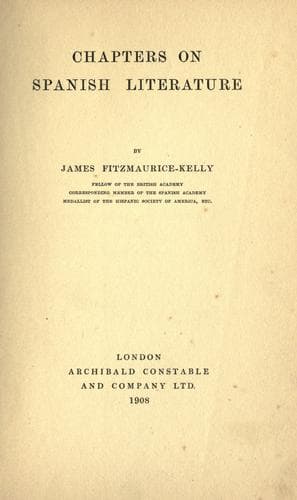
Chapters on Spanish LiteratureFitzmaurice-Kelly, James
History
Chapters on Spanish Literature
Fitzmaurice-Kelly, James
Spanish literature; Spanish literature -- History and criticism
These exhibitions of verbal ingenuity are a blemish in the early
chapters of _Don Quixote_ and in _Romeo and Juliet_. At this stage of
their development both Cervantes and Shakespeare were struggling to
disengage their genius from the clutch of contemporary affectation, and
both succeeded. As _Don Quixote_ progresses the parody of the books
of chivalry becomes less insistent, the style grows more supple and
adaptable, reaches a high level of restrained eloquence in the knight’s
speeches, is forcible and familiar in expressing the squire’s artful
simplicity, is invariably appropriate in the mouths of men differing so
widely from each other as Vivaldo and the Barber, Ginés de Pasamonte
and Cardenio, Don Fernando and the left-handed landlord, the Captive
and the village priest. The dramatic fitness of the dialogue in _Don
Quixote_, its intense life and speedy movement are striking innovations
in the development of the Spanish novel, and give the book its abiding
air of modernity. Cervantes had discovered the great secret that truth
is a more essential element of artistic beauty than all the academic
elegance in the world.
But the immediate triumph of _Don Quixote_ was not due—or, at
least, was not mainly due—to strictly artistic qualities. These
make an irresistible appeal to us, who belong to a more analytic
and sophisticated generation. To contemporary readers the charm of
_Don Quixote_ lay in its amalgamation of imaginative and realistic
elements, in its accumulated episodes, in its infinite sympathy, and
its pervasive humour. There was no question then as to whether _Don
Quixote_ was a well of symbolic doctrine. The canvas was crowded with
types familiar to every one who had eyes to see his companions on
the dusty highways of Spain. The wenches who served Don Quixote with
stockfish and black bread; the lad Andrés, flayed in the grove of oaks
by Juan Haldudo the Rich, of Quintanar; the goatherds seated round
the fire on which the pot of salted goat was simmering; the three
lively needle-makers from the Colt of Córdoba; the midnight procession
escorting the dead body from Baeza to Segovia, and chanting dirges
on the road; the dozen galley-slaves tramping on, strung together
like beads on an iron chain—all these are observed and presented with
masterly precision of detail. But the really triumphant creations of
the book are, of course, Don Quixote and Sancho Panza—the impassioned
idealist and the incarnation of gross common-sense. They were instantly
accepted as great representative figures; the adventures of the
fearless Manchegan madman and his timorous practical squire were
speedily reprinted in the capital and the provinces; and within six
months a writer in Valladolid assumed as a matter of course that his
correspondent in the Portuguese Indies must have made the acquaintance
of Don Quixote and Sancho Panza.
Public-domain text, read in full here on John Shaqi.
Reviews
Reviews
No reviews yet
Be the first to share your thoughts on this work.
Elsewhere in the archive
Join the Discussion
Join the discussion
Sign in to leave a comment or review.
Sign InorCreate an account