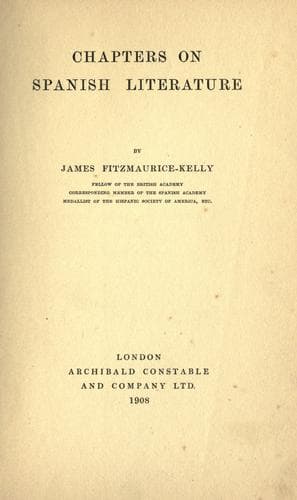
Chapters on Spanish LiteratureFitzmaurice-Kelly, James
History
Chapters on Spanish Literature
Fitzmaurice-Kelly, James
Spanish literature; Spanish literature -- History and criticism
Las orejas mayores que de añal burrico,
el su pescueço negro, ancho, velloso, chico,
las narises muy gordas, luengas, de çarapico,
beueria en pocos djas cavdal de buhon rico.
He thinks nothing beneath his notice, takes you with him into
convent-kitchens and lets you listen to Trotaconventos while she
rattles off the untranslatable names of the dainties which mitigate the
nuns’ austerities:—
Comjnada, alixandria, conel buen diagargante,
el diaçitron abatys, con el fino gengibrante,
mjel rrosado, diaçimjnjo, diantioso va delante,
e la rroseta nouela que deujera desjr ante.
adraguea e alfenjque conel estomatricon,
e la garriofilota con dia margariton,
tria sandalix muy fyno con diasanturion,
que es, para doñear, preciado e noble don.
And, in the same precise way, he satisfies your intelligent curiosity
as to musical instruments:—
araujgo non quiere la viuela de arco,
çiufonja, gujtarra non son de aqueste marco,
çitola, odreçillo non amar caguyl hallaço,
mas aman la tauerna e sotar con vellaco.
albogues e mandurria caramjllo e çanpolla
non se pagan de araujgo quanto dellos boloña....
The medley is sometimes incoherent, but even when most diffuse it never
fails to entertain. To us the vivid rendering of small, characteristic
particulars is a source of delight. The Archpriest threw it off as a
matter of course; but he piqued himself on the boldness of his metrical
innovations, and he had good reason to be proud. Most of his verses
are written in the quatrain of the _mester de clerecía_, or _quaderna
vía_—an adaptation of the French alexandrine or ‘fourteener’—but he
imparts to the measure a new flexibility, and he attempts rhythmical
experiments, moved by a desire to transplant to Castile the metrical
devices which had already penetrated into Portugal and Galicia from
Northern France and Provence. But the Archpriest has higher claims to
distinction than any based on executive skill. He lends a distinct
personal touch to all his subjects. He has an intense impression of
the visible world, an imposing faculty of evocation, and what he saw
we are privileged to see in his puissant and realistic transcription.
Some modern Spaniards, with a show of indignation which seems quaint
in countrymen of Cervantes and Quevedo, reject the notion that humour
is a characteristic quality of the Spanish genius. We must bear these
sputterings of storm with such equanimity as we can, and hope for finer
weather. The fact remains: Juan Ruiz is the earliest of the great
Spanish humourists; he is also the most eminent Spanish poet of the
Middle Ages, and, all things considered, the most brilliant literary
figure in Spanish history till the coming of Garcilaso de la Vega.
Public-domain text, read in full here on John Shaqi.
Reviews
Reviews
No reviews yet
Be the first to share your thoughts on this work.
Join the Discussion
Join the discussion
Sign in to leave a comment or review.
Sign InorCreate an account