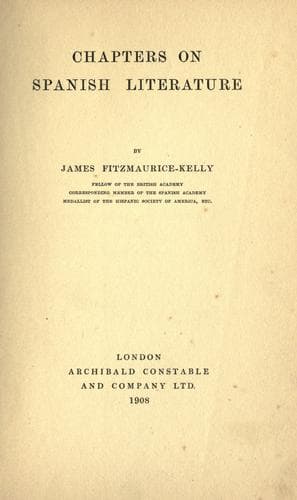
Chapters on Spanish LiteratureFitzmaurice-Kelly, James
History
Chapters on Spanish Literature
Fitzmaurice-Kelly, James
Spanish literature; Spanish literature -- History and criticism
Those of you who have read _Carlos VI. en la Rápita_—one of the latest
volumes in the series of _Episodios Nacionales_—will call to mind
another Juan Ruiz, likewise an Archpriest, known to his parishioners as
‘Don Juanondón,’ and you may remember that this Archpriest of Ulldecona
quotes his namesake, the Archpriest of Hita:—
Tu, Señora, da me agora
la tu graçia toda ora,
que te sirua toda vja.
As the _Libro de buen amor_ had been in print for some seventy years
before the Pretender made the laughable fiasco described by Pérez
Galdós, it is quite possible that Don Juanondón had read the first
of the _Goços de Santa Maria_ in the supplement. But it is not very
likely: for, though the Archpriest’s poems are mentioned in an English
book published nine years before they appeared in Spain,[5] they
never were, and perhaps never will be, popular in the ordinary sense.
Juan Ruiz was far in advance of his age. He lived and died obscure.
No contemporary mentions him by name, and the only thing that can be
construed into a rather early allusion is found in a poem by Ferrant
Manuel de Lando in the _Cancionero de Baena_ (No. 362):—
Señor Juan Alfonso, pintor de taurique
qual fue Pitas Payas, el de la fablilla.
But this, at the best, is indirect. Santillana merely refers to the
Archpriest incidentally. Argote de Molina, in the next century, does
indeed quote one of the Archpriest’s _serranillas_ (st. 1023-27);
but he is misinformed as to the author, and ascribes the verses to
a certain ‘Domingo Abad de los Romances’ whose name occurs in the
_Repartimiento de Sevilla_. Still there is evidence to prove that
Juan Ruiz found a few readers fit to appreciate him. A fragment of
his work exists in Portuguese; the great Chancellor, Pero López de
Ayala, imitates him in the poem generally known as the _Rimado de
Palacio_; Alfonso Martínez de Toledo, Archpriest of Talavera and a
kindred spirit in some respects, speaks of him by name, and lays him
under contribution in the _Reprobación del amor mundano_. The famous
pander who lends her name to the _Celestina_ is closely related to
Trotaconventos, and Calixto and Melibea in that great masterpiece are
developed from Don Melón de la Uerta and Doña Endrina de Calatayud.
The Archpriest’s influence on his successors is therefore undeniable.
But, leaving this aside, and judging him solely by his immediate,
positive achievement, he is not altogether unworthy to be placed near
Chaucer,—the poet to whom he has been so often compared.
CHAPTER III
THE LITERARY COURT OF JUAN II.
Public-domain text, read in full here on John Shaqi.
Reviews
Reviews
No reviews yet
Be the first to share your thoughts on this work.
Join the Discussion
Join the discussion
Sign in to leave a comment or review.
Sign InorCreate an account