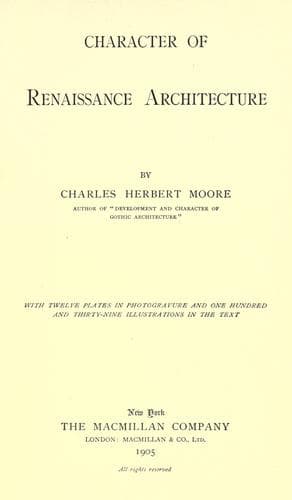
Character of Renaissance ArchitectureMoore, Charles Herbert
History
Character of Renaissance Architecture
Moore, Charles Herbert
Architecture, Renaissance
In a corresponding spirit the architect now set himself to the task
of producing a luxurious and specious style of palatial architecture,
drawing his inspiration from the monuments of imperial Rome, and the
sculptor and the painter sought to portray physical beauty as the
primary and sufficient end of their art. Their conceptions of this
beauty were in part drawn from the remains of the art of classic
antiquity that were then accessible. But the ancient works of art known
at that time were not those of the best periods of ancient artistic
culture. They were, for the most part, works of the decadent Greek
schools as represented in Roman copies. Many of these have, indeed, a
great deal of sensuous charm, and display much technical refinement;
but they are wanting in the nobler qualities that characterize the
finest arts of Greece. From the Roman copies of fauns, Apollos, and
Venuses that had been preserved in Italy, it was impossible that high
inspiration and true guidance should be drawn.
The Fine Arts of the Renaissance are in part a reflection of this
decadent art of classic antiquity, and in part an expression of
something quite different which was peculiar to the Italian genius at
this time. To the man of the Renaissance the classic inspiration was
necessarily different from what it had been to the man of antiquity.
To the ancient Greek and Roman the pagan ideals had been real, and
their inspiration was genuine; but to the Italian of the fifteenth
century these ideals could not have the same meaning, or supply a true
incentive. After the intervening centuries of Christian thought and
experience it was impossible for men to approach the ancient themes in
the spirit of the ancients. Thus the Neo-pagan Art of the Renaissance
is not wholly spontaneous and sincere. It contains elements that are
foreign to the pagan spirit, and not compatible with it. The art of
the Renaissance is, in fact, an embodiment of heterogeneous ideas and
conflicting aims.
Public-domain text, read in full here on John Shaqi.
Reviews
Reviews
No reviews yet
Be the first to share your thoughts on this work.
Join the Discussion
Join the discussion
Sign in to leave a comment or review.
Sign InorCreate an account