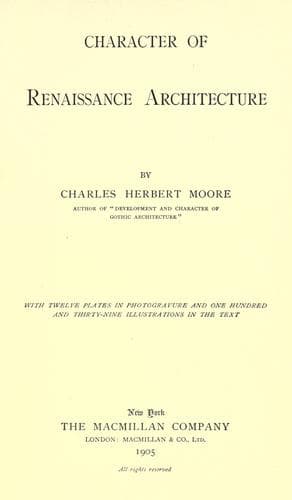
Character of Renaissance ArchitectureMoore, Charles Herbert
History
Character of Renaissance Architecture
Moore, Charles Herbert
Architecture, Renaissance
Much has been said of the importance of the Renaissance movement in
developing the individual man, and it is true that one of the most
marked characteristics of the artistic productions of this time, as
contrasted with those of the Middle Ages, is a distinctly individual,
or personal, stamp. This is especially marked in architecture. Whereas
before, and during, the Middle Ages in particular, architecture had
been a communal art, the joint product of companies of men working
together on traditional lines, with common aims and aspirations, it
was now become very largely an expression of the personal tastes of
individuals working independently of each other. The architects of the
Renaissance were scholars and artists, newly acquainted with the Roman
antique, animated with desire to appropriate what they apprehended of
its principles, and at the same time ambitious to achieve personal
fame. A building of the Renaissance is thus always the product of the
fancy of a particular designer, as a building of the Middle Ages is
not. But architecture of the highest excellence can hardly be produced
by an individual working independently. The noblest architecture of
the past has always been an evolution of a people, the joint product
of many minds, and the natural expression of many conditions. The
importance of the opportunity for the development of the individual
opened by the Renaissance has been exaggerated, and the conditions
conducive to such development which had existed before have been too
much overlooked. We are apt to forget that the mediæval communal life
stimulated the faculties of the individual in many noble ways, and we
do not always enough consider that individuality may be exercised in
harmful as well as in salutary directions. The individuality that had
been developed by the institutions and the intellectual life of the
Middle Ages was vastly different from that which was produced by the
influences of the Renaissance, and it was in many ways more excellent.
The individuality of the Middle Ages was obedient to the demands
of corporate and coöperative life, while that of the Renaissance
was independent and capricious. Conditions favourable to individual
development had arisen early in the Middle Ages in connection with
organized monastic life. The cultivation of literature, philosophy, and
the Fine Arts in the monasteries had given considerable range to the
exercise of individual powers,[3] though in limited directions, and
the rise of the great communal organizations tended still further to
stimulate an admirable individual development. But the individual of
the Middle Ages felt himself a part of an organized body from which he
derived moral support, and with which he felt that he must coöperate.
It was the strong communal spirit, giving unity of purpose to the
varied faculties of individuals, that made possible the production of
the noble arts of the Middle Ages; and it is as the expression of this
Public-domain text, read in full here on John Shaqi.
Reviews
Reviews
No reviews yet
Be the first to share your thoughts on this work.
Join the Discussion
Join the discussion
Sign in to leave a comment or review.
Sign InorCreate an account