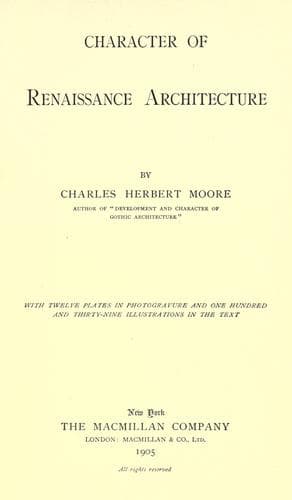
Character of Renaissance ArchitectureMoore, Charles Herbert
History
Character of Renaissance Architecture
Moore, Charles Herbert
Architecture, Renaissance
Angelo, Michael, 90;
design for the tomb of Pope Julius II., 46;
his work on St. Peter’s, 53–65 (cuts), 237;
date of his appointment as architect of St. Peter’s, 53;
his alterations of Bramante’s plan, 53, 70;
his admiration for the dome of Florence cathedral, 55;
quoted on the Pantheon dome, 55;
defects in his scheme, 63, 64;
his makeshifts, 66;
windows of Palazzo Farnese, Rome, 116, 117 (cut).
Angle, Roman treatment of the, 79 (cut);
pilasters on the, 78–81 (cut).
Arabesque, Renaissance in imitation of Roman, 167 (cuts).
Arcades, of the court of Palazzo Farnese, use of Roman combination
of arch and entablature, 118;
cloister of Santa Maria della Pace, Rome, 119;
château of La Rochefoucauld, France, Flamboyant arches framed
with pilasters, 188.
Arch, the radical nature of the change wrought in architecture by
the introduction of, was never grasped by the imperial Roman
designers, 37;
the Roman triumphal, used as a model of Renaissance façades, 38,
39–43 (cuts);
the Roman arch and entablature scheme applied to a continuous
arcade, 118, 119;
of Flamboyant depressed or three-centred form, 184, 188.
Architectural carving of the Renaissance, 167–178 (cuts).
_See_ Carving, Architectural.
Architectural shams, use of, in the Renaissance, 32, 121, 132.
Architecture, the communal and individual spirit in, 4, 5;
its division into three distinctive styles and two classes, 6, 7;
proper meaning of the term, 15^2;
structural integrity a fundamental prerequisite of good, 24;
use of structural members without structural meaning violates the
true principles of architectural design, 68;
mechanical rules cannot reach the law of the proportions of a
genuine work of art, 133, 207, 249;
conscious effort to be original in, is inevitably disastrous,
206;
the noblest, has always been mainly a social, communal, and
national, not a personal product, 206.
Arezzo, church of Santissima Annunziatta, 83;
nave, 83 (cut).
Arnolfo, his design for the dome of Florence cathedral, 13 (cut),
16.
Artificial elements in architectural ornamentation, use of, 172.
Assisi, church of Santa Maria degli Angeli, 89;
date, 89;
general plan, 89;
chapels, 90;
orders, 90 (cut);
piers, 90 (cut);
ressauts, 90;
influence of St. Peter’s in, 90;
façade, 90.
Athens, the Propylæa, spacing of the columns of the order, 113;
National Museum, leafage of capital from Epidaurus, 174 (cut).
Attic wall, use in an interior as a support for vaulting, 151, 243;
of the façade of the chapel of the Pazzi, Florence, 31;
of Michael Angelo’s dome of St. Peter’s, Rome, 54.
Public-domain text, read in full here on John Shaqi.
Reviews
Reviews
No reviews yet
Be the first to share your thoughts on this work.
Elsewhere in the archive
Join the Discussion
Join the discussion
Sign in to leave a comment or review.
Sign InorCreate an account