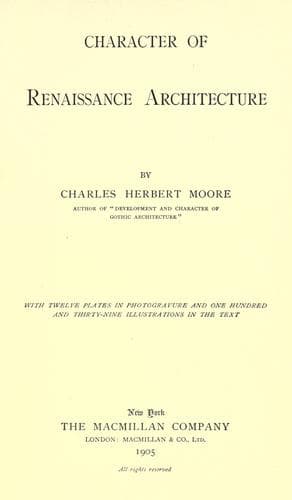
Character of Renaissance ArchitectureMoore, Charles Herbert
History
Character of Renaissance Architecture
Moore, Charles Herbert
Architecture, Renaissance
unity of purpose coördinating the fine artistic energies of the time,
that these arts are preëminently notable. In so far as the development
of the individual in the period of the Renaissance differed from that
of the Middle Ages, it did so mainly in favouring individual caprice
at the expense of harmonious collective effort. The capricious and
irresponsible individuality of the time, together with the confused
complexity of ideas and aims, gave rise to most of that which is open
to criticism in the Fine Arts of the Renaissance.
Nearly all of the architects of this epoch were sculptors and painters.
Few of them had ever had a thorough training in architectural design
and construction, such as had been general with the members of the
great mediæval building corporations; and hardly any of them were
endowed with a natural aptitude for logical construction. The artistic
genius of the Italian people has, in fact, always been essentially a
genius for painting, and the painter’s habits of mind are constantly
manifested in the Italian architecture of all epochs. This is
especially noticeable in their use of the Orders, which is rarely
based on any structural need, but is governed only by the fancy of the
designer in seeking to produce a pleasant surface composition. Columns
and pilasters, answering to nothing in the real structural scheme of
a building, are disposed with no thought save for agreeable lines and
rhythmical spacings. Thus they soon came to be used in many novel ways.
They were set in pairs, stretched through several stories, embraced
by pediments, and varied in countless fanciful ways. In this way the
architecture of the Renaissance even more than that of imperial Rome,
became a mere surface architecture differing fundamentally from all of
the great architectural systems of ancient times, and of the Middle
Ages. This is a consideration of capital importance of which too little
account has been taken. The unqualified and short-sighted laudation of
this architecture by the sophisticated writers of the sixteenth century
has been too readily accepted, and a more discriminating judgment
cannot fail to alter materially the esteem in which it has been held.
Public-domain text, read in full here on John Shaqi.
Reviews
Reviews
No reviews yet
Be the first to share your thoughts on this work.
Join the Discussion
Join the discussion
Sign in to leave a comment or review.
Sign InorCreate an account