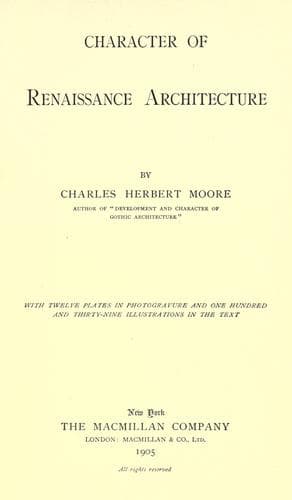
Character of Renaissance ArchitectureMoore, Charles Herbert
History
Character of Renaissance Architecture
Moore, Charles Herbert
Architecture, Renaissance
As to the permanent stability of this dome various opinions have been
held by the experts among the older writers.[23] Its form is, as we
have seen, as favourable to stability as it would be possible to make
that of any vault which could be properly called a dome. It appears
to the inexperienced eye as stable as a crest of the Apennines. Every
precaution as to material and careful workmanship seems to have been
taken to make it secure. The wall of the drum on which it rests is five
metres in thickness, and the solid base of the dome itself is built, if
the architect’s scheme was carried out as he had stated it before the
Board of Works, of large blocks of hard stone, thoroughly bonded and
clamped with iron. The lower system is sufficiently strong, and appears
to rest on a solid foundation. But nevertheless there are ruptures in
various parts of the structure which have caused apprehensions of
danger,[24] and its future duration must be regarded as uncertain.
The writers who have maintained that it is secure have argued on the
assumption that the parts of a dome all tend toward the centre.[25]
These writers overlook the fact that the force of gravity above,
especially when the dome is heavily weighed by a lantern, neutralizes
the inward tendency of the lower parts and causes a tendency in those
parts to movement in the opposite direction. This neutralizing force is
lessened by giving the dome a pointed form, as Brunelleschi has done,
but, as before remarked (p. 22), it can hardly be overcome entirely so
long as any real dome shape is preserved.[26]
It may be thought that the object which Brunelleschi had in view,
of producing a vast dome that should be an imposing feature of the
cathedral externally, justifies the unsound method of construction
to which he resorted (the only method by which the effect that he
sought could be attained). But structural integrity is, I think,
so fundamental a prerequisite of good architecture that in so far
as this gifted Florentine was obliged to ignore sound principles
of construction in order to attain an end not compatible with such
principles, the result cannot be properly considered as an entirely
noble and exemplary work of art, however much beauty and impressiveness
it may have.
The example set by Brunelleschi was, in point of construction, a
pernicious one, and bore fruit of a still more objectionable character
in the works of other gifted men less scrupulous than he, and less
endowed with mechanical ingenuity, as we shall see farther on.
Public-domain text, read in full here on John Shaqi.
Reviews
Reviews
No reviews yet
Be the first to share your thoughts on this work.
Join the Discussion
Join the discussion
Sign in to leave a comment or review.
Sign InorCreate an account