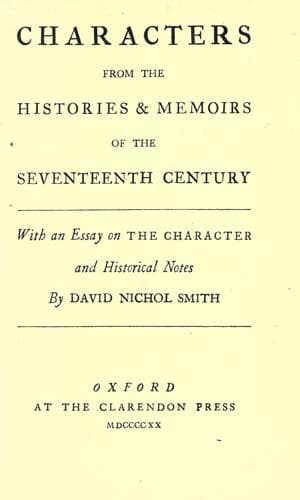
Characters from the Histories & Memoirs of the Seventeenth Century
History
Characters from the Histories & Memoirs of the Seventeenth Century
Great Britain -- Biography; Great Britain -- History -- Stuarts, 1603-1714
The classical historians who were best known were Thucydides,
Polybius, and Plutarch among the Greeks, and Sallust, Livy, Tacitus,
and Suetonius among the Latins; and the former group were not so well
known as the latter. It was recognized that in Thucydides, to use
Hobbes's words, 'the faculty of writing history is at the highest.'[2]
But Thucydides was a difficult author, and neither he nor Polybius
exerted the same direct influence as the Latin historians who had
imitated them, or learned from them. Most of what can be traced
ultimately to the Greeks came to England in the seventeenth century
through Latin channels. Every educated man had been trained in Latin,
and was as familiar with it for literary purposes as with his native
tongue. Further, the main types of history--the history of a long
period of years, the history of recent events, and the biographical
history--were all so admirably represented in Latin that it was not
necessary to go to Greek for a model. In one respect Latin could claim
pre-eminence. It might possess no single passage greater than the
character study of Pericles or of the Athenians by Thucydides, but it
developed the character study into a recognized and clearly defined
element in historical narrative. Livy provided a pattern of narrative
on a grand scale. For 'exquisite eloquence' he was held not to
have his equal.[3] But of all the Latin historians, Tacitus had the
greatest influence. 'There is no learning so proper for the direction
of the life of man as Historie; there is no historie so well worth the
reading as Tacitus. Hee hath written the most matter with best conceit
in fewest words of any Historiographer ancient or moderne.'[4] This
had been said at the beginning of the first English translation of
Tacitus, and it was the view generally held when he came to be better
known. He appealed to Englishmen of the seventeenth century like no
other historian. They felt the human interest of a narrative based
on what the writer had experienced for himself; and they found
that its political wisdom could be applied, or even applied itself
spontaneously, to their own circumstances. They were widely read in
the classics. They knew how Plutarch depicted character in his Lives,
and Cicero in his Speeches. They knew all the Latin historians. But
when they wrote their own characters their chief master was Tacitus.
* * * * *
Public-domain text, read in full here on John Shaqi.
Reviews
Reviews
No reviews yet
Be the first to share your thoughts on this work.
Join the Discussion
Join the discussion
Sign in to leave a comment or review.
Sign InorCreate an account